

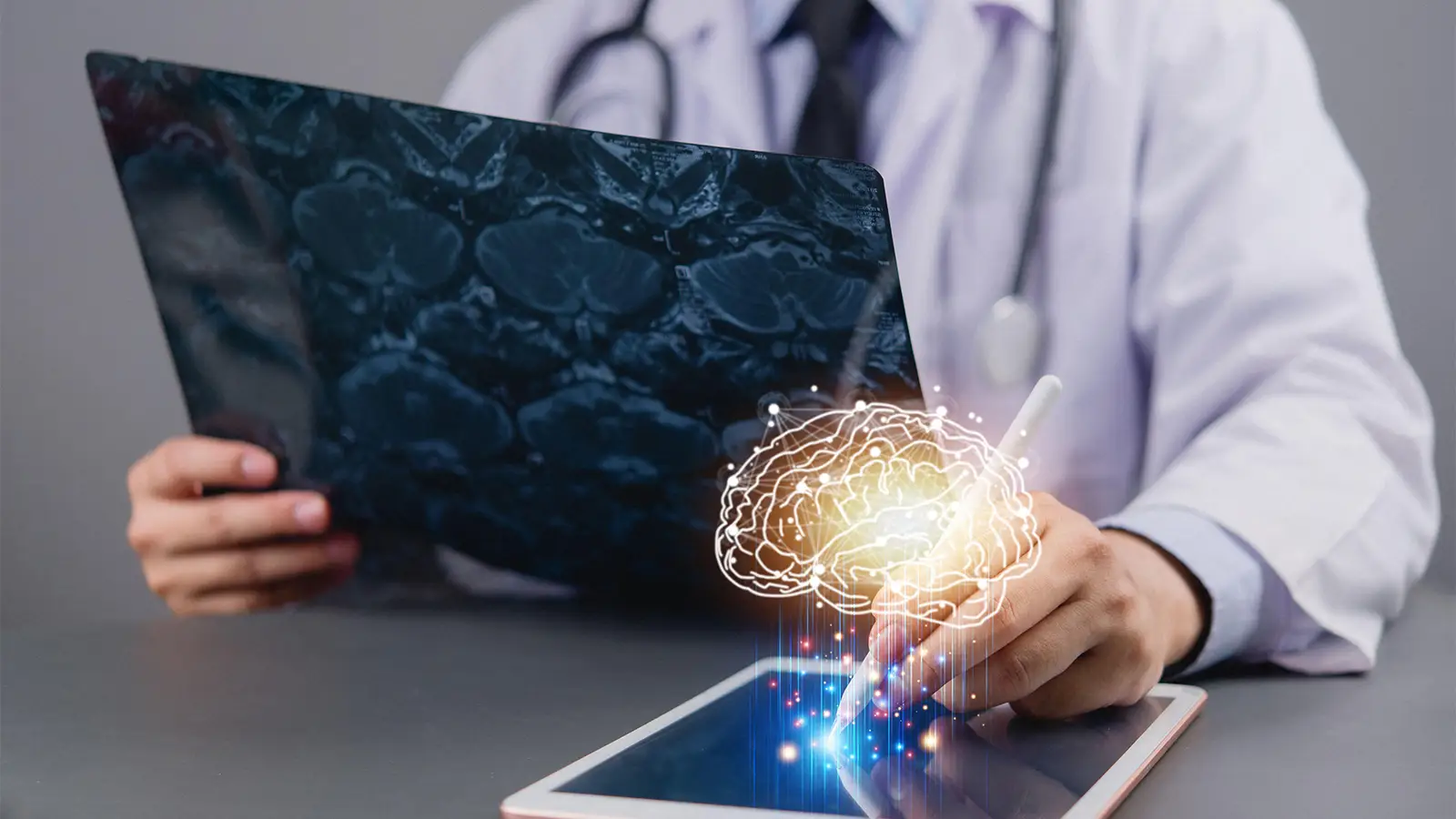
There’s been a lot written in the media lately about the risks and benefits of deskilling.
Smarter and smarter artificial intelligence (AI) systems are taking over countless tasks across every aspect of society, from the mundane to the complete replacement of somebody’s job.
Students are asking AI to do their homework, read a book and summarize it, help them study for the SATs, write their college entrance essays. People in offices are having AI answer their emails, summarize their meetings, keep track of their invoices. And we’re starting to see it cropping up in more and more places across healthcare.
When a tool can help us accomplish a task, do something that doesn’t require much brain power and is really just a drain on our time, it’s a win-win for everybody.
When we start asking it to take over the things that make us more human, that make us good students, that make us good employees, that make us compassionate and wise nurses and doctors, then we’re heading for trouble.
How do we figure out where to draw these lines?
If there’s something that I think will make my life better, but someone else thinks I should be doing it without AI, who gets to decide?
Remember in high school when we all asked, “Why do we have to learn algebra, I’m never going to use this in my life,” but some teacher insisted we go through the process, master this mathematical construct, tuck another skill under our belts, if only for the sake of learning how to approach a problem and use our brains.
In healthcare, we’re getting access to more resources online, and more tools in the palms of our hands that will help us guide our patients toward the best health decisions.
In the old days, we had to go to the library, read journals, read the textbooks, consult with a wise mentor or specialist, ask a friend. Now it seems like most of the answers are just a click away.
But is this the best thing for health and healthcare?
I remember my first rotation at the VA hospital in San Francisco, a terrified summer intern just a few weeks out of medical school, rounding on incredibly sick patients. Everyone told me I was incredibly lucky to have the attending who was on service that month as our supervisor, an incredible clinician with a soft and brilliant bedside manner and amazing auscultatory and palpation skills.
One of those first mornings on rounds, he asked the brand-new cardiology fellow to describe what he found on exam and to let us know what he thought the plan should be for the day.
This was a patient with advanced heart failure who had come in with a severe exacerbation and was on the edge of complete decompensation. The fellow described what he found on physical exam and lab tests, and said he wanted to order an echocardiogram, stat.
But why get an echocardiogram, asked the attending, when everything you need to know is right there.
This classically trained older physician walked us through the patient’s physical exam, from the quality of his peripheral pulses to the impact of his heart against his chest wall, to the indicators of elevated central venous pressure, all visible to the well-trained eyes and ears and hands.
He drew out on a piece of chart paper the patient’s cardiac waveform, and in the end, told us what the patient’s ejection fraction would be on the echocardiogram that we would get later in the day.
Nowadays it seems like everyone’s cardiac exam in the chart says heart regular, normal S1, S2, no murmurs, rubs, or gallops.
Sure, it’s easy to get an echocardiogram, but sometimes if you have the skills, you can know what to do without it.
Recently we’ve learned there is new technology emerging, including stethoscopes that will tell you what valve is causing that murmur and what the cardiac ejection fraction is. Wi-Fi-enabled dermatoscopes are now churning through millions of images and risk stratifying skin lesions into malignant or nonmalignant. AI systems are reading mammograms, finding abnormalities in CT scan images, spotting that one abnormal cell in an ocean of cells on a stained bone marrow biopsy.
While these incredible tools are likely to revolutionize the healthcare system, they are simultaneously deskilling us, making us less willing and able to make these clinical decisions on our own.
If we never read a book but have the AI tell us what it said, are we better off? Are we well-read?
If we never again interpret an echocardiogram on our own, but rely on the computer to tell us whether there’s a heart attack or atrial fibrillation or left ventricular hypertrophy, are we better off? Are our patients better off?
I hate to think about the day that the power goes out, that we’re stuck without these really amazing (and potentially scary) tools.
I turn to them every day; I click on the links to the online tools that serve as my peripheral brain. We all do it. And I don’t think there’s anything wrong with it, but maybe it’s worth slowing down, thinking about what we might be losing by growing too dependent on these things.
As long as they’re perfect, as long as they’re always right and never wrong, as long as they never miss anything or lead us down a false pathway, it will probably be best for patients. But I worry that we will be losing some of the heart and soul and humanity inherent in the practice of medicine.
Maybe we can find a way to get and use these cool new toys but keep the tried-and-true skills tucked away in our back pockets.
Just in case.




Leave a Reply