

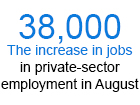
Private-sector employment increased by 38,000 jobs in August, according to the latest “ADP National Employment Report.” For all private-sector workers in the United States, base pay rose 3.2 percent, while gross pay increased 4.7 percent year over year, according to ADP Pay Insights.
Base pay for job stayers rose 3.0 percent year over year, while base pay for job changers increased 4.7 percent. Gross pay for job stayers rose 4.4 percent year over year, while gross pay for job changers increased 7.3 percent.
“Pay can tell us a lot about today’s choppy hiring. To understand hiring patterns, you have to look deeply into where pay growth is accelerating, where it’s slowing and for whom,” said Dr. Nela Richardson, chief economist at ADP.
The goods-producing sector recorded a decline of 10,000 jobs. Natural resources and mining employment decreased by 5,000, while construction added 12,000 jobs. Manufacturing employment fell by 17,000.
The service-providing sector gained 48,000 jobs overall. Education and health services led the gains with 45,000 new jobs, followed by leisure and hospitality with 16,000 and financial activities and other services, each with 6,000. These gains were partially offset by declines in professional and business services, which lost 16,000 jobs; information, which lost 4,000; and trade, transportation and utilities, which declined by 5,000.
Regionally, the Northeast gained 38,000 jobs, including increases of 12,000 in New England and 26,000 in the Mid-Atlantic. The Midwest added 5,000 jobs overall, with a decline of 15,000 in the East North Central region offset by a gain of 20,000 in the West North Central region. The South gained 3,000 jobs, with the South Atlantic adding 14,000 while the East South Central and West South Central regions lost 2,000 and 9,000 jobs, respectively. The West was the only region to record an overall decline, losing 8,000 jobs, including decreases of 3,000 in the Mountain region and 5,000 in the Pacific region.
By establishment size, small businesses gained 3,000 jobs overall. Establishments with one to 19 employees added 20,000 jobs, while those with 20 to 49 employees lost 17,000. Medium-sized establishments recorded no overall change, with businesses employing 50 to 249 people gaining 2,000 jobs and those with 250 to 499 employees losing 2,000. Large establishments recorded the strongest gains, adding 34,000 jobs, all of which came from businesses with 500 or more employees.
Base and gross pay are valuable indicators of labor market conditions. Base pay changes tend to be long-lasting, and changes in this structural metric can signal labor market tightness or inflationary pressure. Gross pay measures total compensation generated by labor market activity. The data can be used to assess income growth and consumer spending power. Changes in gross pay can indicate how employers are responding to atypical economic conditions.
“Once predictable wage growth has been overtaken by complexities of demographic change, persistent inflation and AI’s effects on jobs,” Dr. Richardson said.




Leave a Reply