

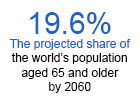
The share of the world’s population aged 65 and older is projected to nearly double, from 10.5 percent to 19.6 percent, between 2025 and 2060, according to a new report released by the U.S. Census Bureau. The report, titled “An Aging World: 2025,” finds that the global population is aging faster than ever before. Between 2020 and 2025, the proportion of the population aged 65 and older exceeded the population age 5 and younger for the first time in recorded history.
In 2025, the United States ranked 48th among 227 countries and areas in terms of population age, with 18.9 percent of its population age 65 and older. By 2060, older adults are projected to make up 23.4 percent of the U.S. population. Yet the United States will fall to 110th place globally because other countries are aging much more rapidly. Japan was the world’s oldest country in 2025, with 29.7 percent of its population aged 65 and older. By 2060, South Korea is projected to become the oldest country, with 41 percent of its population age 65 and older.
Europe is currently the world’s oldest region, with the percentage of its population aged 65 and older projected to increase from 21 percent to 30.8 percent between 2025 and 2060. However, in sheer numbers, the youngest region, Africa, is projected to have more older people than Europe. By 2060, Africa is projected to have 249 million people aged 65 and older, compared with 214 million in Europe.
Declining fertility and worldwide improvements in healthcare, educational attainment and economic development have contributed to a growing older population across regions. The report highlights how this growth may affect healthcare systems, employment and overall financial, physical and mental well-being.
Life expectancy is projected to increase faster than healthy life expectancy, meaning a smaller share of the additional years people live is expected to be spent in good health. In the United States, for example, the proportion of years lived in full health after age 60 decreased by more than 2 percentage points between 2000 and 2019, with the decline slightly greater among men than women.
An estimated 73 percent of the U.S. population age 65 and older had two or more chronic conditions between 2016 and 2019. Globally, Alzheimer’s disease and other dementias ranked among the five leading causes of death among people aged 60 and older as of 2021.
The financial pressures associated with an aging population are also expected to grow. Over the next decade, average government health spending across Organisation for Economic Co-operation and Development (OECD) countries is projected to increase by 2.6 percent of gross domestic product, twice the average growth in government revenues, which is projected at 1.3 percent of GDP. This disparity is expected to create a growing imbalance between healthcare costs and government revenues.
The COVID-19 pandemic amplified many of the challenges faced by older people. Many lost jobs and access to healthcare, caregiver support and other essential services. A lack of digital connectivity made communication more difficult for some, while social isolation became an even greater concern.
Unpaid caregiving by family members and friends remains the main source of long-term care for older people worldwide. In many OECD countries, three out of five caregivers aged 50 and older are women, highlighting the significant role women continue to play in providing unpaid care.
Older adults also continue to participate in the workforce, although trends vary by income level. The labor force participation rate for people aged 65 and older in high-income countries increased between 2012 and 2022, while many low- and middle-income countries experienced a decline during the same period.
Older adults also contribute significantly through volunteer work. In the United Kingdom, 56.2 percent of adults aged 65 and older volunteered their time between 2021 and 2023, a rate considerably higher than that of most countries worldwide.
Public pension coverage varies substantially between countries. Public pensions may replace more than 90 percent of average wages in countries such as Brazil, Turkey, the Netherlands and Argentina, while replacement rates are closer to 50 percent in countries including the United States, Canada, India, New Zealand, Japan and South Africa.
Financial security in old age also varies dramatically around the world. South Korea’s exceptionally high old-age poverty rate, which was above 40 percent in both 2015 and 2020, stands in sharp contrast to Norway, the Netherlands and Hungary, where the old-age poverty rate remained below 10 percent during the same period.




Leave a Reply