

An extended peak import season is continuing, according to the National Retail Federation and Hackett Associates Global Port Tracker. The NRF predicts another surge expected this month that could make September the busiest month of the year for import volume at the nation’s major container ports.
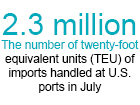
U.S. ports covered by Global Port Tracker handled 2.3 million twenty-foot equivalent units in July, the latest month for which final numbers are available. That was down 3.9 percent from a year earlier but up 3.2 percent from June.
“We thought the peak season would be mostly behind us by now, but that’s not the case,” NRF vice president for supply chain and customs policy Jonathan Gold said. “Some of the shift from earlier in the summer to now is because of vessel delays due to bad weather in China and some rerouting away from the Panama Canal amid potential drought conditions there. But consumers keep buying despite tariffs, inflation and high fuel prices, and retailers keep bringing in merchandise to meet demand.”
Ports have not yet reported August numbers, but the Global Port Tracker projected the month at 2.29 million TEU, down 1.3 percent year over year. September is forecast at 2.31 million TEU, up 9.6 percent year over year and slightly ahead of July as the busiest month of the year.
As recently as last month, it appeared that May’s 2.24 million TEU would be the busiest month of 2026 as retailers brought in merchandise early ahead of potential increases in tariffs, the NRF said in a statement. The organization added that high import levels continued, stretching out the peak season to its traditional timing of late summer and early fall.
“Imports have remained buoyant over the past three months despite several hurdles,” Hackett Associates founder Ben Hackett said, citing tariff increases along with inflation and rising fuel prices related to the conflict in Iran. “Retail sales remain strong and cargo is moving relatively smoothly, although there are reports of vessel delays and increased times required for cargo to move through the supply chain.”
Cargo volume is expected to drop to 2.11 million TEU in October, but will still be up 1.7 percent year over year. November is forecast at 2 million TEU, down 0.9 percent year over year, and December at 2.03 million TEU, up 1.1 percent over last year. Those numbers would bring 2026 to a total of 25.7 million TEU, up 1 percent from last year’s 25.4 million TEU. The first half of 2026 totaled 12.7 million TEU, up 1.1 percent from the same period in 2025. January 2027 is forecast at 2.09 million TEU, down 1 percent year over year, the report concluded.




Leave a Reply