

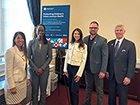
(L to R) The Congressional briefing featured insights from Charissa Lee, OD, Johnson & Johnson Vision; Afua Asare, OD, University of Utah School of Medicine; Felicia Timmermann, OD, CooperVision; Ryan Parker, OD, EssilorLuxottica; and David Cockrell, OD, chair of HCAPS.
WASHINGTON, D.C.—The Health Care Alliance for Patient Safety (HCAPS) briefed Congressional leaders on Sept. 15, 2026, about the prevalence of myopia and protecting children’s vision and eye health, according to an announcement from the American Optometric Association. A 2024 National Academies of Sciences, Engineering, and Medicine consensus report on myopia and its key findings were discussed as well as the notion that as myopia in children becomes more prevalent, optometrists can translate their knowledge about vision and eye health into greater awareness, earlier diagnoses, and better access to appropriate care.
Led by David Cockrell, OD, chair of HCAPS and past president of the American Optometric Association (AOA), the briefing also featured insights from Charissa Lee, OD, head of North America professional affairs for Johnson & Johnson Vision; Felicia Timmermann, OD, senior advisor for myopia management at CooperVision; and Ryan Parker, OD, senior director of professional affairs at EssilorLuxottica. The briefing came just two weeks after Dr. Cockrell joined national health leaders at the U.S. Department of Health and Human Services’ Live Real Life Symposium to ensure children’s vision, myopia and the importance of early eyecare were part of the discussion.
“Today’s briefing brought together leading experts to highlight the growing challenge of childhood myopia and the importance of early detection, appropriate referrals and comprehensive eyecare,” said Dr. Cockrell. “We have an opportunity to translate scientific evidence into meaningful public health action, and HCAPS is committed to working with policymakers and stakeholders to help educate, raise awareness and advocate for our priorities.”
The briefing opened with an introduction to myopia, including the potential long-term consequences of progressive myopia and the relationship between healthy vision and academic performance, child development and overall well-being. The optometrists explained the importance of identifying vision concerns through early screening and of closing the referral loop between the screening and a comprehensive eye exam. The doctors emphasized the need for greater public understanding of myopia among parents, educators, schools and communities.
Afua Asare, OD, a health services researcher at the University of Utah School of Medicine, then discussed the 2024 National Academies of Sciences, Engineering, and Medicine consensus report Myopia: Causes, Prevention, and Treatment of an Increasingly Common Disease. She explained that scientific evidence supports greater public awareness and stronger vision health education as important components of addressing childhood myopia.
Dr. Asare, who served on the expert committee that produced the report, highlighted several key findings, including that uneven awareness of children’s eye health is one of the most significant barriers to children receiving appropriate vision care and that the U.S. Department of Health & Human Services (HHS) has an important role in ensuring children receive timely vision screening and appropriate referrals for comprehensive eye examinations.
The speakers concluded the briefing by connecting the scientific findings to a practical federal policy opportunity: the Early Detection of Vision Impairments for Children (EDVI) Act. The proposed legislation would fund the first national program dedicated to children’s vision and eye health and the doctors encouraged members of Congress and their staff to support the legislation.
The EDVI Act models the bipartisan success of the Early Hearing Detection and Intervention (EHDI) program that has drastically increased screening and referral to care for infants with hearing loss since 1999. It would authorize $10 million for each fiscal year through 2030 to be used for implementing early detection and intervention for vision concerns in children, raising public awareness of the importance of children’s vision and eye health, reducing disparities in eye health and developing state-based data collection, surveillance and performance improvement systems.
“HCAPS supports the EDVI Act because it would give states and communities the resources they need to strengthen early detection, establish appropriate referrals to eyecare and ensure children receive the follow-up care they need,” Dr. Cockrell said. “Too often, identifying a potential vision problem is only the first step, and children can fall through the cracks before receiving the comprehensive care they need.”




Leave a Reply