

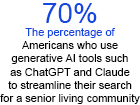
More Americans are relying on AI to help choose senior living communities for their loved ones. A new survey from U.S. News & World Report, a global authority in healthcare decision support, reveals that more than two-thirds (70 percent) use generative AI tools such as ChatGPT and Claude to streamline their search. This shift is being driven significantly by younger family members, particularly grandchildren, who are adopting AI at the highest rates to research care options, draft inquiries and vet safety records for their grandparents, the report said.
As AI acts as an initial filter during a family’s search for a senior living community, operators are now engaging with prospective residents and families who arrive far more informed than in years past. However, before making a final decision about a community, consumers rely heavily on independent validation through trusted sources, connections with staff and impressions from in-person tours.
Adults ages 18 to 44 are driving adoption at the highest rates, using AI not only for discovery (53 percent) and side-by-side facility comparisons, but also to draft outreach emails (33 percent) and investigate safety records and complaints (32 percent).
Across all age groups, 82 percent of AI users say they would trust an AI recommendation enough to book a tour of a senior living community. Willingness to act on AI suggestions is highest among adults ages 18 to 44 (88 percent), compared with 61 percent of adults 65 and older. Despite trusting AI to shortlist options, 75 percent of respondents agree or strongly agree that they would not make a final decision without cross-referencing an independent evaluator.
Among respondents with sufficient experience to judge accuracy, 51 percent reported encountering incorrect AI-generated data. Top discrepancies included misstated care levels and amenities (60 percent), incorrect community availability or wait times (44 percent), outdated pricing (35 percent) and errors citing nonexistent communities (21 percent).
While AI tools help narrow the field, personal interactions with residents and staff carry the most weight in the decision-making process (40 percent). Additionally, 43 percent of respondents identified a positive “gut feeling” during an on-site tour as the deciding factor that gave them confidence to sign a residency agreement.
More than half of families (52 percent) say clear pricing and fee structures are essential when visiting a senior living community’s website, while 34 percent emphasize the importance of seeing first-person reviews from residents and families to validate their decision.
“While AI tools help families to quickly evaluate options and gather key information upfront, our research shows that senior living communities must educate and serve the digital savvy consumers by providing third-party trusted independent ratings and price transparency online,” said Sumita Singh, executive vice president of health at U.S. News. “U.S. News’ research findings emphasize that communities need a multi-pronged strategy entailing not only third-party validation of their services, but also the tried and true onsite staff development and a strong consumer brand to effectively differentiate in an AI search-enabled world.”




Leave a Reply