

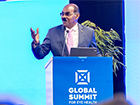
Gaston Browne, prime minister of Antigua and Barbuda addresses Summit attendees.
ST. JOHN’S, Antigua and Barbuda—Last week, the inaugural Global Summit for Eye Health drew more than 40 governments to St. John’s to tackle the challenge of avoidable vision loss worldwide. Convened by the International Agency for the Prevention of Blindness (IAPB), hosted by the government of Antigua and Barbuda, and co-hosted by the governments of Bangladesh, Guyana, Ireland and Nigeria in technical collaboration with the World Health Organization (WHO), the Summit met its goal with more than $1 billion committed globally to improve access to eyecare screening, spectacles and treatment.
In total, 200 commitments were secured at the Summit which will benefit millions of people worldwide, organizers said. Full details of all commitments have now been published following the conclusion of the Summit and can be filtered by country, region, organization type, commitment type, eye health priorities or thematic areas.
In addition to national governments, health leaders, development partners, and businesses, the Summit was supported by high impact partners whose contributions, event organizers said, united leaders, experts and advocates to drive evidence-based action and lasting impact.
Vision Monday had the opportunity to connect with some of the partners on-site and after the event about their own commitments and plans for the future.
Kathleen Sherwin from Orbis, and Laurent Attias from Alcon spoke with Vision Monday at the Global Summit for Eye Health in St. John’s.
Alcon
“For our part, Alcon has committed to providing advanced surgical training to at least 3,000 additional ophthalmologists working in underserved communities by 2030,” Laurent Attias, SVP of corporate strategy, business development and licensing and mergers and acquisitions at Alcon told VMAIL. “We will extend our hub-and-spoke training network to Egypt and Peru in 2027 and to other regions after that. No single organization can close the gap alone, so we hope others will step forward alongside Alcon and our partners.”
On improving access to eyecare globally, Franck Leveiller, Ph.D., SVP, global research and development, and chief scientific officer for Alcon told VMAIL that proven treatments already exist. “What’s missing in many communities is capacity: enough trained professionals, reliable equipment, infrastructure and sustainable delivery models, along with quality care that is affordable. One of the biggest impacts the private sector can make is investing in people. One well-trained surgeon, with the right infrastructure, can perform up to 2,000 cataract surgeries a year, so training multiplies impact. Innovation matters, and it lies at the core of what we do, but we should judge it by whether it can be taught, maintained and delivered at scale.”
Orbis International
Meaningful progress for Orbis means expanding access and empowering more governments to incorporate eyecare into their national health systems, Kathleen Sherwin, president and CEO of Orbis, told VMAIL. “At the Summit, Orbis is announcing an estimated US $32 million commitment for 2027-2030. This includes training 250,000 eyecare professionals; directing US $17 million of that commitment toward cataract-surgery training, resources and expertise; and working with the government of Antigua and Barbuda to integrate AI-assisted screening into routine diabetes care. Through these commitments, Orbis is reaffirming its mission to restore sight and prevent vision loss where the need is greatest.”
Sightsavers
“Access to eyecare services such as glasses, cataract surgery and treatment for trachoma or river blindness will make a difference to education, livelihood and independence,” Sumrana Yasmin, technical director for inclusive health at Sightsavers, told VMAIL. “Global leaders have given us hope for a future where no one is left behind, regardless of income, gender, background or circumstances.
Honorable Michael Joseph, minister of health, wellness, environment & civil service affairs for Antigua and Barbuda greets HRH the Duchess of Edinburgh to the Global Summit for Eye Health.
“We now need to make sure that becomes reality. No one organization can do this alone. To support efforts, we commit to work with governments and partners to strengthen health services, save and protect sight, and help more people live full, independent lives. This will include supporting eyecare professionals, bringing services closer to communities, and ensuring vision and eyecare is part of health, education, livelihood and road safety programs.
“By working together, we can boost eyecare services so that they reach far and wide. In a world of complex problems, eyecare is an issue where we can transform lives now, while making a positive difference for future generations,” said Yasmin.
Zeiss
“As one of the world’s leading ophthalmic technology companies, Zeiss is uniquely positioned to anchor our commitment focused on what remains the leading cause of blindness worldwide: cataracts,” said Steve Schallhorn, MD, chief medical officer, Zeiss Medical Technology in a statement. “To address this will require close collaboration with ophthalmologists, healthcare providers, and partners like IAPB who share our commitment to better patient outcomes.”
The company announced it intents to build on community based eyecare and country-led visual health awareness campaigns with the goal of reaching an additional 1 million people per year for each of the following commitments:
The Summit concluded with a musical performance by Antigua’s own Annia.
- Scaling access: Zeiss said it aims to scale the successful Indian Aloka Vision model to at least two additional countries until 2028, expanding access to post-cataract care.
- Strengthening local eyecare: The company intends to work with partners and governments to develop country enablement programs, focusing on driving visual health awareness, expanding education and training, and donating certified equipment, glasses and intraocular lenses through outreach and cataract programs.
Other high impact partners of the Global summit include CBM (Christian Blind Mission), The Chen Yet-Sen Family Foundation, CooperVision, the Cure Blindness Project, The Fred Hollows Foundation, Johnson & Johnson, National Vision, RestoringVision, Santen and the Seva Foundation.
More details about each organization’s commitments can be found through the Global Summit for Eye Health’s portal here.




Leave a Reply