

Import volumes at the nation’s major container ports are expected to decline for the remainder of the year following an extended peak season that has kept ports busy since Spring, according to the latest Global Port Tracker report from the National Retail Federation and Hackett Associates.
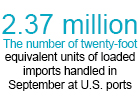
U.S. ports covered by the Global Port Tracker handled 2.37 million twenty-foot equivalent units (TEUs) of loaded imports in September, the latest month for which final figures are available. That was up 3.4 percent from August and 12.6 percent year over year, making September the busiest month of 2026 amid the extended peak season. It was the third-busiest month since the Global Port Tracker began keeping records, surpassed only by July 2025, with 2.39 million TEUs, and May 2022, with 2.4 million TEUs.
“U.S. ports have seen high volume levels throughout this year’s longer-than-usual peak season and numbers are still strong even as the season winds down,” NRF vice president for supply chain and customs policy Jonathan Gold said.
A strike was averted earlier this month when International Longshore and Warehouse Union Local 26, which represents watchmen at several container terminals at the Ports of Los Angeles and Long Beach, reached a short-term contract extension with the Pacific Maritime Association. The contract has now been extended three times, each for a few days, most recently through Nov. 20. No long-term agreement is in place following the previous contract’s expiration in July 2025.
“Unfortunately, these volumes have led to backups at some ports, particularly on the West Coast where cargo has sat for extended periods waiting to be transferred to rail cars,” added Gold. “We’ve also seen the threat of a strike at the nation’s largest port complex in recent days. Nonetheless, most holiday merchandise is already here, and retailers are working closely with their supply chain partners to ensure that the supply of holiday gifts continues to flow smoothly.”
Hackett Associates founder Ben Hackett said this year’s months-long peak season was an extension of the prolonged season in 2025, when a series of tariff increases prompted retailers to bring in merchandise before the tariffs took effect.
“At the start of 2026, that surge appeared to have ended after the Supreme Court struck down high ‘Liberation Day’ tariffs. Expectations of another extended peak season consequently faded,” Hackett said. “However, new tariffs introduced in the second quarter prompted a renewed surge in imports beginning in May that continued through mid-October. Consumer spending supported this influx, with households continuing to buy despite rising inflation.”
Ports have not yet reported October figures, but the Global Port Tracker projected the month’s volume at 2.26 million TEUs, up 9.1 percent year over year. November is forecast at 2.05 million TEUs, up 1.2 percent year over year, while December is expected to reach 2.03 million TEUs, up 1.3 percent. Those figures would bring 2026 import volumes to 26 million TEUs, up 2 percent from 25.4 million TEUs in 2025. The first half of 2026 totaled 12.7 million TEUs, up 1.1 percent from the same period in 2025.
January 2027 is forecast at 2.04 million TEUs, down 3 percent year over year. February is expected to reach 1.89 million TEUs, down 0.5 percent, while March is forecast at 1.92 million TEUs, down 11.2 percent.




Leave a Reply