

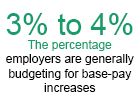
U.S. companies are planning to keep salary increase budgets steady in 2027, according to The Conference Board’s annual survey. New data reveals that employers are generally budgeting 3 percent to 4 percent for base-pay increases, with a median of 3.5 percent, unchanged from the 2026 median. That does not mean every worker will receive a 3.5 percent raise. How those dollars are distributed will vary by industry, employee level and role, performance and the value particular skills bring to business priorities.
With limited room to increase spending broadly, employers are becoming more targeted in their pay decisions. The median “other” increase budget—a flexibility pool for promotions, pay equity, market adjustments, retention and critical skills—is just 0.5 percent. Employers therefore face increasingly difficult choices about where to direct limited compensation dollars.
Nowhere is that shift more evident than in the growing value placed on AI skills, with 37.8 percent of organizations reporting that AI and machine-learning skills are driving base-pay increases, more than any other specific skill category surveyed. Yet formal pay structures have not kept pace, with 63 percent still basing salary ranges entirely on an employee’s job rather than skills, and just 3.4 percent specifically budgeting “other” increases for employees who acquire in-demand skills.
Human capabilities remain highly valued as well, with 30.7 percent of organizations citing leadership and people-management skills as influencing base-pay adjustments, and 30.4 percent citing data science and advanced analytics.
“Salary budgets may be holding steady, but the compensation landscape is anything but static,” said Diana Scott, U.S. human capital center leader, The Conference Board. “Employers have to make tougher choices about where limited compensation dollars will have the greatest impact. The opportunity is to move beyond across-the-board thinking and more deliberately reward performance, critical skills, and the capabilities that will drive future growth.”
Industry differences remain, with projected median salary increases ranging from 3.7 percent in technology, telecommunications and information services to approximately 3.0 percent in wholesale and retail trade, as well as government, nonprofit and education.
“AI skills are commanding a premium, but the data make clear that technical expertise alone isn’t enough,” said Rita Meyerson, EdD, principal researcher, human capital, The Conference Board. “As AI becomes more embedded in how work gets done, organizations also need leaders who can guide teams through change, make sound decisions, and translate technology into business results. The workforce of the future will require both AI fluency and strong human skills.”
Although 31 percent of employers expect headcount to grow in 2027, just 9 percent anticipate workforce reductions. At the same time, employers report increasing use of automation, restructuring, upskilling, hot-skill hiring and reductions in force. This suggests that companies are not simply shrinking or expanding their workforces. Instead, they are removing or automating certain types of work while investing more heavily in the roles and skills that support growth, technology and organizational transformation.
Stable executive salaries put more weight on incentives. Executive base-pay increases are also projected at 3.5 percent, broadly in line with increases for other employee groups. However, incentives continue to play a significant role in executive compensation, with median annual incentive plan targets equal to 40 percent of base pay for executives and 100 percent for CEOs.
Financial performance remains the primary factor in determining executive incentive payouts, with 79 percent of organizations using it as a measure. By comparison, 29 percent use operational measures, and 23 percent consider strategic or other nonfinancial goals.
“With executive salary increases holding steady, incentive pay is becoming an even more important tool for aligning leadership with business priorities,” said JoAnne Moeller, senior fellow and program director, The Conference Board. “The opportunity is to reward not only financial performance, but measurable progress on productivity, AI investment and workforce transformation—the outcomes that will drive long-term value.”




Leave a Reply