

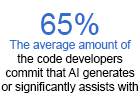
A new report reveals that despite the growing use of AI in code development, confidence in AI-generated code remains low. The report, the “State of Code Developer Survey Report 2027” from Sonar, a global leader in agentic code verification and governance, reveals that AI now generates or significantly assists with an average of 65 percent of the code developers commit.
The report notes that work is becoming more autonomous: 34 percent of respondents expect their teams to create or use agentic software factories within a year, compared with 5 percent currently.
But as more organizations mobilize systems of agents to work autonomously across development tasks, teams need to be able to keep pace. Seventy-six percent say they generate AI code faster than they can verify it, and 53 percent spend more time reviewing code than creating it today, compared with 18 percent before adopting AI tools.
Despite this review burden, AI-generated code is not consistently checked. Only 39 percent completely agree that AI-generated code is always checked before being committed, even though 94 percent don’t fully trust it.
While 42 percent say they’re very or extremely concerned that well-written AI code makes bugs harder to spot, surprisingly, only 23 percent have well-defined, AI-specific guidelines or automated checks that set clear standards for AI-generated code. With 76 percent saying their teams use AI coding tools for business-critical or mission-critical services, building code confidence isn’t a nice-to-have; it’s a necessity, the report shows.
“AI has made code abundant. The challenge now is building confidence in what ships, as evident by the responses in our latest State of Code report,” said Tariq Shaukat, CEO of Sonar.
The survey finds that 37 percent name unclear requirements among their top sources of toil work, and 26 percent cite correcting or rewriting AI-generated code. Providing explicit business objectives, architecture standards, quality criteria and security requirements at the start gives agents a target to deliver on and teams a basis for assessing their work.
Teams that give coding agents clear standards and controls are more likely to report an ROI of 50 percent or more than teams with few controls. Giving agents relevant context and rules as they write code helps them follow coding standards and stay within limits on tool access and permissions.
Seventy-seven percent of developers and engineering managers report that strong verification tools increase their trust in AI code. Independent checks and fixes before release build confidence that code meets standards, rather than trusting the code simply because it looks correct.
Only 36 percent say their team measures AI’s productivity impact and that they can see the results, while 22 percent are unsure what return AI coding has delivered. Tracking outcomes and recording what was checked, found and fixed helps teams assess value and substantiate release decisions.
“As seven times more teams expect to build agentic software factories in the next year, they can not rely on having a human in the loop to inspect every line at the end,” Shaukat said. “Instead, confidence needs to be engineered into the factory itself: clear intent, guide rails that guide and govern agents, independent verification, and evidence of what was checked and fixed. After all, the goal is not simply to produce more code. The goal is to ship more secure, reliable software that delivers business value.”




Leave a Reply