

Gregori M. Kurtzman, DDS
Introduction
Orthodontic tooth movement depends on the ability of the periodontal ligament (PDL) and surrounding alveolar bone to respond to controlled mechanical forces. Brackets, wires, and clear aligners provide that force. But, the patient’s biological response ultimately determines how efficiently movement occurs. Orthodontic therapy is therefore more than mechanical repositioning of teeth, it is a continuous process of bone resorption and formation around the moving tooth.1-3
Gregori M. Kurtzman, DDS
Increasing orthodontic force does not necessarily produce faster movement. Excessive force may instead contribute to tissue hyalinization, discomfort, periodontal damage, and potentially root resorption. This has created interest in adjuncts that may enhance a positive biological response without increasing orthodontic force that can have negative consequences.
One approach is low-magnitude high-frequency vibration (LMHFV). Vibration produces alveolar bone remodeling by stimulating cellular processes that regulate osteoclast-mediated bone resorption and osteoblast-mediated bone formation.4,5 In this manner, LMHFV directly targets the central biologic process required for orthodontic tooth movement. The concept is attractive because the stimulus is noninvasive and requires relatively little treatment time. However, vibration is not a single treatment modality. Frequency, magnitude, duration, and method of application vary considerably, which may help explain conflicting results in the literature.6-9
Orthodontic Tooth Movement Is a Bone Remodeling Process
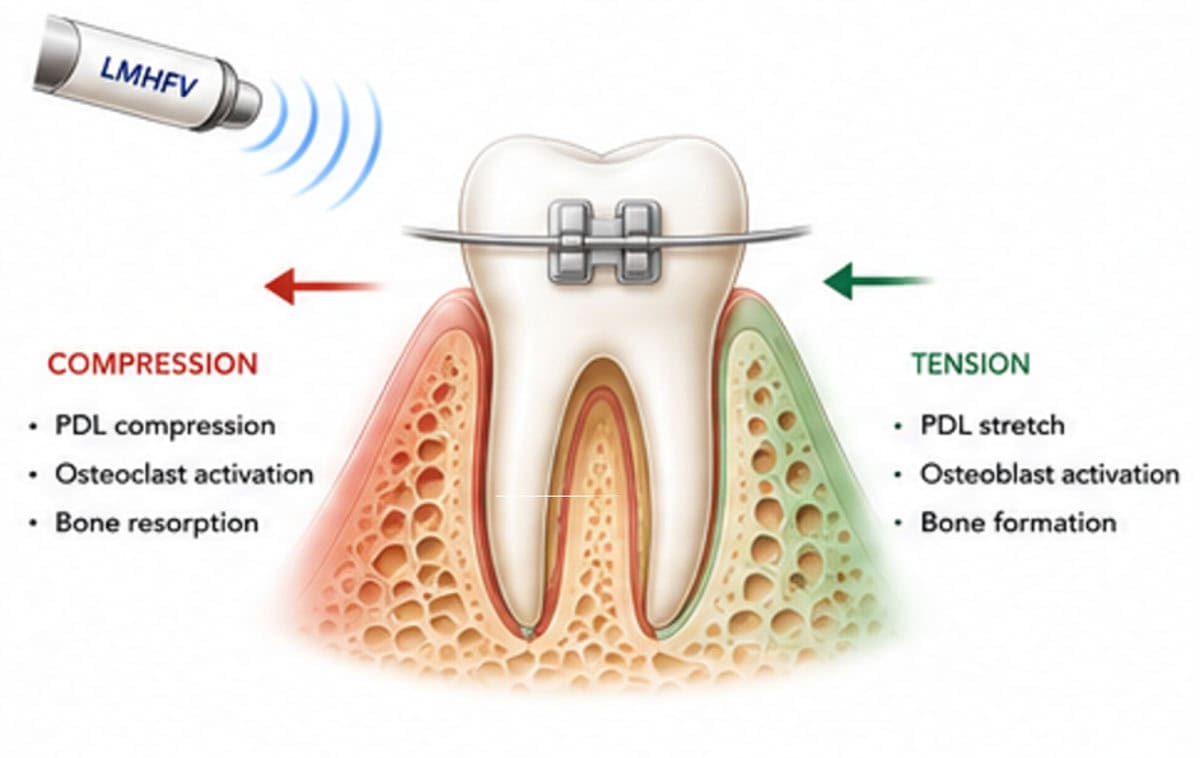
When orthodontic force is applied to the teeth, it is transmitted through the PDL to the surrounding alveolar bone, producing areas of compression and tension. This mechanical deformation initiates cellular and molecular events that allow the tooth to move through the alveolus.1-3 Osteoclast differentiation and activity increase on the pressure (compression) side, permitting bone removal in the direction of movement, while osteoblast activity contributes to new bone formation on the opposing (tension) side (Figure 1).
Figure 1. Orthodontic force creates compression and tension within the PDL, initiating coordinated bone resorption and bone formation. LMHFV provides an additional mechanical stimulus that can influence cellular signaling and the remodeling environment surrounding the moving tooth.
Osteocytes also play an important role. Those cells function as mechanosensors, detecting changes in their mechanical environment and transmitting signals that regulate osteoblast and osteoclast activity.1-3Orthodontic treatment thus depends on mechanotransduction, the conversion of a mechanical stimulus into a cellular and biochemical response. Clinically, the appliance applies the force, but the tissues determine the response.
A central regulatory pathway involves RANK (Receptor Activator of Nuclear Factor Kappa-B), RANKL (receptor activator of nuclear factor kappa-B ligand), and osteoprotegerin (OPG).2,3 RANKL binds RANK on osteoclast precursors and promotes osteoclast formation and activity. OPG acts as a decoy receptor, limiting this interaction. Mechanical stress can increase the RANKL-to-OPG ratio, favoring osteoclastogenesis and bone resorption.2 Dunn demonstrated the importance of this pathway by showing that local OPG delivery inhibited mechanically mediated bone modeling and orthodontic tooth movement.3
Why High-Frequency Vibration Can Influence Bone
Bone is highly responsive to its mechanical environment, and the biologic response is influenced not only by force magnitude but also by frequency. LMHFV is detected by mechanosensitive cells within the PDL and alveolar bone and converted into cellular signals that regulate osteoclast and osteoblast activity. Through these cellular processes, vibration produces alveolar bone remodeling, including bone resorption where the tooth is moving and bone formation on the opposing side. Studies have demonstrated that relatively small mechanical signals delivered at higher frequencies can stimulate osteogenic responses.4,5 Alikhani reported increased bone formation following high-frequency acceleration and subsequently described effects on alveolar bone regeneration and healing.4,5
This is relevant because orthodontic tooth movement requires coordinated bone resorption and formation. LMHFV stimulates the cellular activity responsible for both components of alveolar bone remodeling rather than simply applying more force to the tooth. The potential value of LMHFV can therefore extend beyond simply “moving teeth faster.” High-frequency stimulation has been shown to positively modify the remodeling environment in which orthodontic movement occurs.4,10
Importantly, not all vibration should be considered equivalent. Several randomized trials evaluating lower-frequency vibration failed to demonstrate significant acceleration of tooth movement, and systematic reviews have reported inconsistent clinical benefits.6-9 High-frequency vibration provides a different mechanical stimulus. Evidence indicates that frequency and acceleration can influence inflammatory signaling, osteoclast activity, osteoblast activity, and alveolar remodeling.4,10 The response may also differ depending on whether vibration is delivered with or without an active orthodontic force10 (Figure 2).
Figure 2. The biologic response to mechanical vibration is influenced by multiple parameters, including frequency, magnitude, duration, and application protocol. Findings from low-frequency vibration studies should not necessarily be extrapolated to LMHFV.
These differences help explain why results from lower-frequency devices should not automatically be extrapolated to LMHFV. Encouraging experimental findings suggest that high-frequency stimulation may provide meaningful biologic and clinical benefits, although larger controlled clinical studies are needed to identify the protocols that produce the most predictable and reproducible outcomes.
Clinical Evidence and Clear Aligner Therapy
Shipley evaluated high-frequency vibration as an adjunct to clear aligner treatment in patients with mild-to-moderate crowding. Patients using vibration followed an accelerated aligner protocol and demonstrated shorter treatment times, while CBCT analysis identified changes in alveolar bone density.11 These findings are consistent with evidence that high-frequency mechanical stimulation can influence alveolar bone and limit root resorption.4,5
Clear aligner therapy is an especially interesting application because treatment depends on both biologic remodeling and accurate seating of the appliance. LMHFV may provide two potential benefits. Mechanically, vibration applied with the aligner in place may assist aligner seating over the teeth and attachments, helping the appliance express its programmed forces. Biologically, high-frequency stimulation transmitted through the teeth and PDL may positively modify the remodeling response initiated by orthodontic force. Evidence suggests that high-frequency stimulation combined with active orthodontic force can increase inflammatory and osteoclast-related signaling associated with tooth movement14 (Figure 3).
Figure 3. LMHFV applied while the aligner is fully seated may assist aligner adaptation and support tracking of planned tooth movement. In appropriately selected patients who continue to demonstrate good tracking, studies show that LMHFV supports shorter aligner-change intervals when clinically appropriate.
These effects should be considered separately. Improved seating does not prove accelerated bone remodeling, and enhanced remodeling cannot compensate for a poorly designed or inadequately fitting aligner. LMHFV is best viewed as an adjunct that may support both aligner adaptation and the biologic response to appropriate orthodontic mechanics.
Potential for Shorter Aligner Intervals
One clinically attractive possibility is reducing the interval between aligner changes. If LMHFV enhances remodeling and the teeth reach their programmed positions while maintaining accurate tracking, progression to the next aligner may be possible sooner.11
Shorter intervals, however, should never be based solely on the use of LMHFV. The clinician must evaluate tracking, periodontal health, complexity and type of movement, root anatomy, patient age and compliance, and the amount of movement programmed into each aligner. Advancing before the planned movement has been expressed may create progressive loss of tracking. The objective is not simply to change aligners more frequently, but to maintain efficient, biologically compatible movement synchronized with the planned sequence.
Integrating LMHFV Into Clear Aligner Treatment
From a practical standpoint, LMHFV should not automatically change the aligner schedule simply because the patient is using the device. The first consideration remains whether the aligner is fully seated and the teeth are expressing the programmed movement. LMHFV aids in seating the new aligner on the arch. At each visit, the clinician should evaluate adaptation around the incisal edges, occlusal surfaces, and attachments and look for developing spaces between the aligner and the teeth. If tracking remains accurate and the planned movement is being expressed, a shorter change interval may be considered in an appropriately selected patient. If tracking is incomplete, advancing to the next aligner simply compounds the discrepancy.
Effects on Alveolar Bone and Stabilization
The effect of LMHFV on alveolar bone may ultimately be one of its more important applications. Vibration stimulates the cellular processes that produce alveolar bone remodeling. During active tooth movement, this remodeling requires continuous coordination between osteoclast-mediated bone resorption and osteoblast-mediated bone formation, followed by mineralization and maturation around the repositioned tooth. High-frequency acceleration has been demonstrated to stimulate osteogenic activity within alveolar bone.4,5
This raises the possibility that LMHFV may support not only active remodeling but also subsequent bone formation and maturation. That concept may be particularly relevant in adults, during arch expansion, or when moving teeth in areas with thin facial or lingual bone. It should not, however, be interpreted as a means of overcoming an inadequate alveolar socket or moving teeth beyond biologic limits. Periodontal health, available bone, appropriate force systems, and sound treatment planning remain essential.
Because remodeling continues after active tooth movement retention is a phase in which bone maturation, rather than tooth movement, determines long-term stability. This makes LMHFV a logical adjunct during retention: its osteogenic effects within alveolar bone have been demonstrated experimentally, providing a direct biologic rationale for continuing stimulation after active treatment ends.4,5 A five-minute daily protocol also integrates readily into an established home-care routine, making sustained long-term use realistic in a way that few adjuncts allow. LMHFV is intended to complement rather than replace conventional retention, and controlled studies in the retention phase represent a natural next step for the evidence base.
Orthodontic Discomfort, Root Resorption, and Safety
Vibration has been proposed as a noninvasive method of reducing orthodontic discomfort through altered sensory input, local blood flow, or modulation of inflammation. Clinical trials have demonstrated clinically significant pain reduction.7,9 Improved patient comfort is therefore an additional demonstrated benefit of LMHFV.
Root resorption must also be considered whenever an adjunct is used to influence tooth movement. Available studies have not demonstrated evidence that low-magnitude vibration increases root resorption. More recent randomized and systematic evidence has also been reassuring regarding root integrity and periodontal safety.12,13 Routine clinical and radiographic monitoring should continue, particularly in patients with recognized risk factors (Figure 4).
Figure 4. External apical root resorption is a potential adverse effect of orthodontic tooth movement. Because LMHFV can modify the biologic remodeling environment, it has positive effects on the roots and surrounding bone.
The Clinical Perspective
The clinical appeal of LMHFV is that it provides a noninvasive mechanical stimulus without increasing the magnitude of orthodontic force. Bone and the PDL respond to mechanical stimulation, with osteocytes serving as important mechanosensors that help regulate osteoblast and osteoclast activity.14 LMHFV activates these cellular pathways and thereby produces alveolar bone remodeling. This additional positive stimulus supportsthe coordinated bone resorption and formation required for orthodontic tooth movement.4,10 The direction of that movement remains determined by the orthodontic appliance, which delivers the force system; LMHFV modifies the bone response to that force rather than the movement plan itself (Figure 5).
Figure 5. LMHFV is an adjunct that can enhance the biologic response to appropriate orthodontic forces; it does not replace sound biomechanics.
The important clinical question is whether a particular frequency, magnitude, duration, and application protocol produces enough biologic stimulation to meaningfully improve treatment. Current evidence suggests that how vibration is delivered matters considerably.10,11 This distinction is essential when interpreting the literature: negative results with lower-frequency devices do not necessarily apply to LMHFV, but positive findings with high-frequency stimulation do not mean every patient or movement will respond more rapidly.
In clear aligner therapy, the most immediate applications can be assisting seating and potentially supporting shorter change intervals in patients who maintain accurate tracking. With fixed appliances, the potential benefit is primarily biologic through modulation of the remodeling environment.
LMHFV can also be particularly interesting in adult orthodontic patients, in whom bone turnover may be less robust and treatment is often complicated by periodontal or restorative history. A non-invasive method capable of stimulating the local remodeling environment has obvious appeal, although additional clinical research in this population is needed (Figure 6).
Compliance is also a potential problem. If the process for use in the patient’s daily homecare routine is complex or time-consuming, patient compliance will suffer. Utilization of LMHFV is not complex, nor time-consuming and only requires use of a LMHFV device 5-minutes daily by biting on the device intraorally.
Figure 6. Bone turnover generally decreases with increasing age, potentially influencing the remodeling response during orthodontic tooth movement. LMHFV can provide a noninvasive mechanical stimulus to support remodeling in adult orthodontic patients.
Conclusion
Orthodontic tooth movement is fundamentally a process of mechanically induced periodontal and alveolar bone remodeling. Forces delivered by brackets, wires, or aligners initiate a biologic response involving osteoclasts, osteoblasts, osteocytes, inflammatory mediators, and regulatory pathways including the RANK/RANKL/OPG system.
LMHFV provides an additional mechanical stimulus that activates cellular processes within the PDL and alveolar bone. By regulating osteoclast and osteoblast activity, vibration produces the alveolar bone remodeling required for orthodontic tooth movement. Experimental evidence demonstrates osteogenic effects within alveolar bone, while emerging clinical evidence suggests potential applications in orthodontic tooth movement and clear aligner therapy.4,5,10,11 The literature also makes clear that not all vibration is equivalent; frequency, magnitude, duration, and application protocol are important when interpreting outcomes.
LMHFV is considered an adjunct to sound orthodontic biomechanics. It does not move teeth independently; rather, vibration stimulates the cellular processes that remodel alveolar bone, while the direction in which the teeth move is determined by the orthodontic appliance. This provides a noninvasive means of supporting bone remodeling, aligner tracking, treatment efficiency, and potentially post-movement bone maturation.
References
- Singh A, Gill G, Kaur H, Amhmed M, Jakhu H. Role of osteopontin in bone remodeling and orthodontic tooth movement: a review. Prog Orthod. 2018;19(1):18. doi:10.1186/s40510-018-0216-2. PMID: 29938297.
- Yamaguchi M. RANK/RANKL/OPG during orthodontic tooth movement. Orthod Craniofac Res. 2009;12(2):113-119. doi:10.1111/j.1601-6343.2009.01444.x. PMID: 19419454.
- Dunn MD, Park CH, Kostenuik PJ, Kapila S, Giannobile WV. Local delivery of osteoprotegerin inhibits mechanically mediated bone modeling in orthodontic tooth movement. Bone. 2007;41(3):446-455. doi:10.1016/j.bone.2007.04.194. PMID: 17588510.
- Alikhani M, Khoo E, Alyami B, Raptis M, Salgueiro JM, Oliveira SM, et al. Osteogenic effect of high-frequency acceleration on alveolar bone. J Dent Res. 2012;91(4):413-419. doi:10.1177/0022034512438590.
- Alikhani M, Sangsuwon C, Alansari S, Nervina JM, Teixeira CC. High frequency acceleration: a new tool for alveolar bone regeneration. JSM Dent Surg. 2017;2(4):1026. PMID: 30215055.
- Khera AK, Raghav P, Mehra V, Wadhawan A, Gupta N, Phull TS. Effect of customized vibratory device on orthodontic tooth movement: a prospective randomized control trial. J Orthod Sci. 2022;11:18. doi:10.4103/jos.jos_127_21. PMID: 35754416.
- Katchooi M, Cohanim B, Tai S, Bayirli B, Spiekerman C, Huang G. Effect of supplemental vibration on orthodontic treatment with aligners: a randomized trial. Am J Orthod Dentofacial Orthop. 2018;153(3):336-346. doi:10.1016/j.ajodo.2017.10.017. PMID: 29501108.
- Kumar V, et al. Comparative assessment of the rate of orthodontic tooth movement in adolescent patients undergoing treatment by first bicuspid extraction and en mass retraction, associated with low-frequency mechanical vibrations in passive self-ligating and conventional brackets: a randomized controlled trial. Int Orthod. 2020;18(4). doi:10.1016/j.ortho.2020.08.003. PMID: 33162347.
- El-Angbawi A, McIntyre GT, Fleming PS, Bearn DR. Effects of vibrational devices on orthodontic tooth movement: a systematic review. Am J Orthod Dentofacial Orthop. 2019. PMID: 30477774.
- Alikhani M, Alansari S, Hamidaddin MA, Sangsuwon C, Alyami B, Thirumoorthy SN, et al. Vibration paradox in orthodontics: anabolic and catabolic effects. PLoS One. 2018;13(5):e0196540. PMID: 29734391.
- Shipley TS, Farouk K, El-Bialy TH. Effect of high-frequency vibration on orthodontic tooth movement and bone density. J Orthod Sci. 2019;8:15. PMID: 31497574.
- Teti L, et al. Randomised clinical trial on the effect of intermittent vibrational force application during orthodontic treatment with aligners on root resorption. Orthod Craniofac Res. 2025. doi:10.1111/ocr.70028. PMID: 40927956.
- Sirri MR, et al. Effects of physical adjunctive interventions on root resorption in accelerated orthodontic treatment: a systematic review and meta-analysis. Int Orthod. 2026;24(2S):101123. doi:10.1016/j.ortho.2025.101123. PMID: 41455157.
- Seddiqi H, Klein-Nulend J, Jin J. Osteocyte mechanotransduction in orthodontic tooth movement. Curr Osteoporos Rep. 2023;21(6):731-742. doi:10.1007/s11914-023-00826-2. PMID: 37792246.




Leave a Reply