

On November 9, 2026, the Centers for Medicare & Medicaid Services (CMS) announced second-year state awards from the $50 billion Rural Health Transformation Program (referred to here as the “rural health fund”). The rural health fund was created as part of the July 2025 budget reconciliation law, once known as the “One Big Beautiful Bill,” to help offset the impact of the law on rural areas. In particular, it was projected that the law would reduce federal Medicaid spending by $911 billion over ten years (based on estimates released shortly after enactment), including by an estimated $137 billion in rural areas, according to KFF analysis.
CMS awarded $10 billion in state grants through the rural health fund for fiscal year 2027. CMS did the same for fiscal year 2026 and will continue to do so from fiscal years 2028 through 2030, for a total of $50 billion over five-year period. States had a one-time opportunity to apply for funding, and all states were approved, meaning that they are eligible for funding for all five years of the program, barring any decision by CMS to reduce or eliminate their award.
State awards for fiscal year 2027, the second of five years, average $200 million, ranging from $142 million in New Jersey to $282 million in Texas (Figure 1). Differences in total awards across states in the second year are modest relative to large differences in rural populations and rural health needs more generally (as was the case in the first year of the program and will likely be true in future years). For example, Texas has about thirty times as many rural residents as New Jersey (4.3 million versus about 140,000) but is only receiving about twice as much funding in the second year ($282 million versus $142 million). Differences in total awards across states are relatively modest primarily because half of the rural health fund (50%) is being distributed equally across approved states, regardless of need, as required by law. Because all states have been approved for funding, each is slated to receive $100 million from this half of the fund in each of the five award years.
Texas, Alaska and Montana are receiving the largest total awards in the second year. While Texas has the largest rural population in the country, Alaska and Montana have the fifth- and fifteenth-smallest rural populations, respectively. Alaska and Montana likely received relatively large awards at least in part because a portion of the fund was distributed to the five largest states based on land area. New Jersey, Connecticut, and Rhode Island are receiving the smallest awards in the second year. These are all states with relatively small rural populations.
Second-year awards were within 4% of first-year awards in every state (Figure 2). First and second-year awards were likely similar because most of the rural health fund (75%) is locked in place, barring any decision by CMS to reduce or eliminate the award for a given state. In particular, CMS is required by law to distribute half (50%) of the funding equally across approved states (all 50 states), and the agency is distributing a quarter (25%) of the funding based on measures of state need, calculated once and used for the life of the program. Based on CMS guidance, the remaining quarter (25%) is being distributed based on state initiatives, state policy, and other factors. The distribution of those dollars could change over time, e.g., based on a state’s progress in implementing their initiatives and enacting policies committed to in their applications.
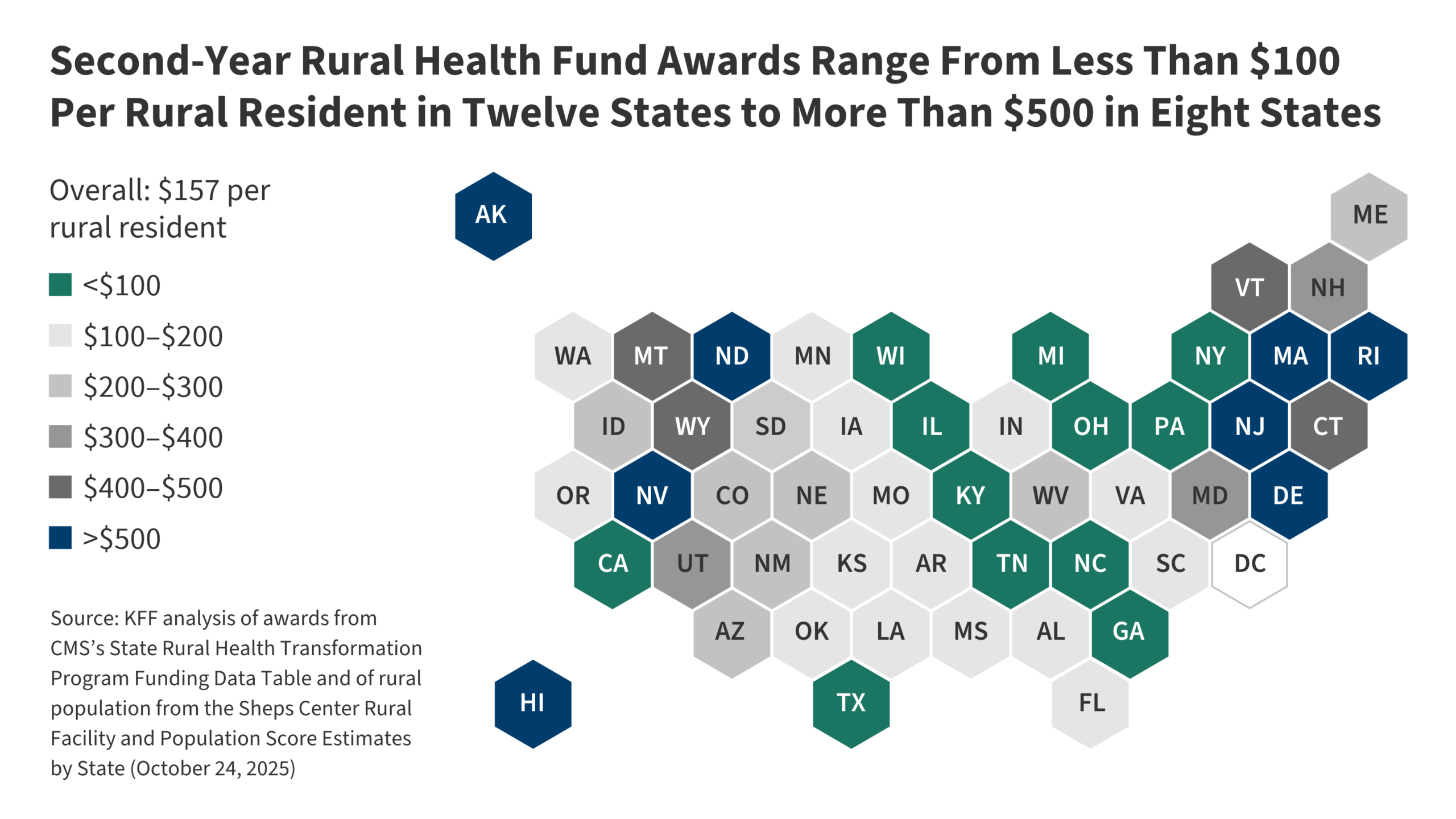
Second-year awards per rural resident vary widely across states, ranging from less than $100 in twelve states to more than $500 in eight states (see Figure 3). State awards are partially, but not closely, tied to rural population, meaning that second-year awards per rural resident are generally relatively small among states with the largest rural populations. For example, Texas has the largest rural population in the country—and the largest total award in the second year—but will receive the smallest payment per rural resident (about $70 in 2026). In contrast, states like Rhode Island, New Jersey, and Alaska, with far fewer rural residents, will receive substantially higher amounts per rural resident (about $6,390, $1,030, and $990 respectively, with Rhode Island being an extreme outlier). Only a quarter of the $50 billion fund is being distributed exclusively based on measures of state need, with just 5% of the fund that is based on rural population. Other measures of need, according to CMS, include the number of rural facilities, land area, the share of hospitals receiving Medicaid disproportionate share hospital (DSH) payments, and other factors.
Second-Year Rural Health Fund Awards Range From Less Than $100 Per Rural Resident in Twelve States to More Than $500 in Eight States
Click on the buttons below to see data for
different charts:
First-Year Awards
 
Second-Year Awards  
Cumulative Awards  
Award per rural resident from $10 billion available through the rural health fund in the first year:
Overall award per rural resident includes all 50 states. DC and the U.S. territories were ineligible for funding. The rural population for each state is defined based on the HRSA definition of “rural”, which CMS uses to allocate a portion of the rural health funds. This definition includes all nonmetropolitan areas as well as some parts of metropolitan areas. Population counts come from the 2020 Census, which is also in line with CMS’s approach.
KFF analysis of awards from CMS’s https://www.medicaid.gov/resources-for-states/rural-health/state-data-maps”>State Rural Health Transformation Program Funding Data Table and of rural population from the Sheps Center Rural Facility and Population Score Estimates by State (October 24, 2025). 🞄 https://files.kff.org/attachment/11159-Figure-3-data-download.xlsx" target=”_blank” rel=”nofollow noopener noreferrer”>Get the data
Second-Year Rural Health Fund Awards Range From Less Than $100 Per Rural Resident in Twelve States to More Than $500 in Eight States
Click on the buttons below to see data for
different charts:
First-Year Awards
 
Second-Year Awards  
Cumulative Awards  
Award per rural resident from $20 billion available through the rural health fund in the first two years:
Overall award per rural resident includes all 50 states. DC and the U.S. territories were ineligible for funding. The rural population for each state is defined based on the HRSA definition of “rural”, which CMS uses to allocate a portion of the rural health funds. This definition includes all nonmetropolitan areas as well as some parts of metropolitan areas. Population counts come from the 2020 Census, which is also in line with CMS’s approach.
KFF analysis of awards from CMS’s https://www.medicaid.gov/resources-for-states/rural-health/state-data-maps”>State Rural Health Transformation Program Funding Data Table and of rural population from the Sheps Center Rural Facility and Population Score Estimates by State (October 24, 2025). 🞄 https://files.kff.org/attachment/11159-Figure-3-data-download.xlsx" target=”_blank” rel=”nofollow noopener noreferrer”>Get the data
It remains to be seen how states will distribute their awards across various activities and entities. State annual and quarterly progress reports to CMS will include standardized information about how much money various entities are receiving from states and for what purposes. A full accounting of first-year obligations to direct recipients will not be available until states submit their first quarterly reports, due November 29, 2026, and the same details about the second round of state awards will not be available until late 2027. While CMS has stated they will release state progress reports to the public upon request, it does not plan to do so proactively. Annual progress reports are available for several, but not all, states from KFF Health News. CMS has released some information about how states are using and obligating funds (such as a summary of the states’ first annual progress reports), and approved plans and budgets are available for most states from KFF Health News. However, unlike the state progress reports, these sources do not reveal how much money is distributed across various entities and how those entities are using the funding.
This work was supported in part by Arnold Ventures. KFF maintains full editorial control over all of its policy analysis, polling, and journalism activities.




Leave a Reply