

Transcript
Andrew Nelson: Welcome to Exploring
Rural Health, a podcast from the Rural Health Information
Hub. My name is Andrew Nelson. In this podcast, we’ll be
talking with a variety of experts about providing rural
healthcare, problems they’ve encountered, and ways in
which those problems can be solved.
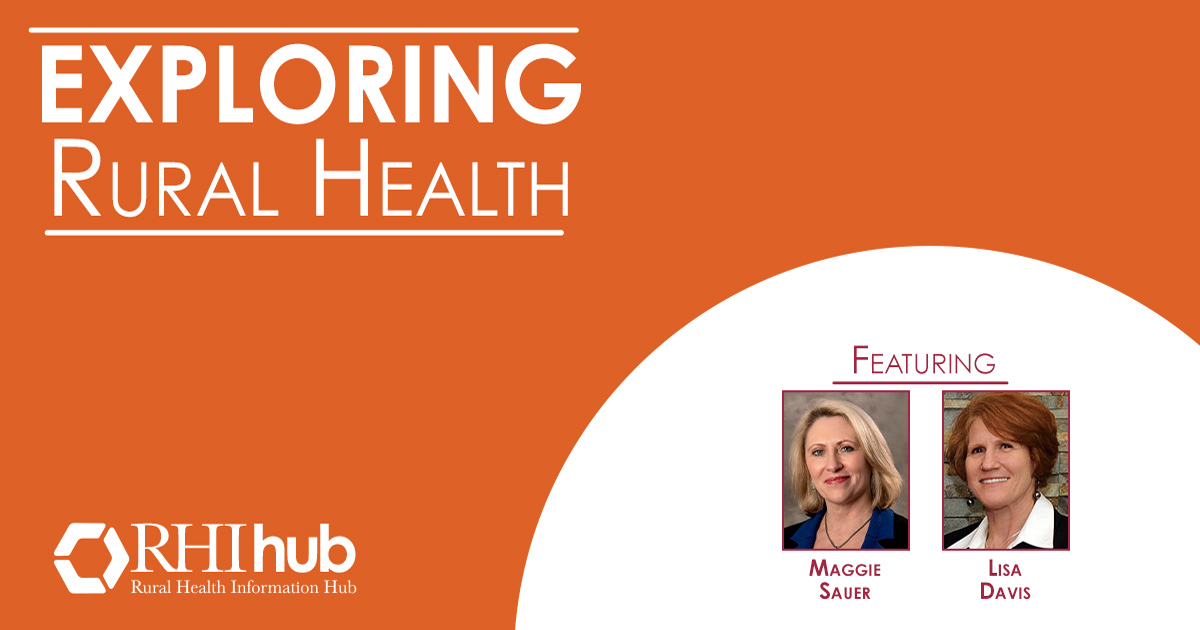
Joining me today is Maggie Sauer, Director of the North
Carolina Office of Rural Health, and Lisa Davis, who’s
just retired from her position as the Director and
Outreach Associate Professor of Health Policy and
Administration at the Pennsylvania Office of Rural
Health.
As I mentioned, Lisa has just retired, and Maggie, I
believe you’re retiring at the end of the year. Do you
want to tell us a little bit about your career and why
you chose to work in rural health originally?
Maggie Sauer: This is a real time of
reflection, and I appreciate the opportunity to be here
with Lisa Davis, who I respect so greatly. I grew up in a
little town in eastern Colorado called Limon. And we had
a farm and a ranch 15 miles outside of town, which meant
that you had to plan your trips to town very carefully,
which also meant you had some intentionality around
scheduling your healthcare. So, I was one of those kids
that thought I was never going back to rural. I was
leaving the town, and I was going to go do something
different. And then I went to school and got my master’s
in speech pathology, and I had the pleasure of going and
helping develop technology for people with disabilities
who are not going to be able to use speech as a primary
mode of communication.
And I think how it comes back to rural health is that,
even in that technology development, even when I went to
go see patients, we never accepted what we saw in the
evaluation site. It was always about following people
home, whether it was home or school or work, to see how
it really continued to work. And so, when I came to North
Carolina 35 years ago, I practiced here at the University
of North Carolina in [the] School of Medicine. And then I
was like, “What is it that’s happening here with people’s
ability to get insurance? What are the policies that
affect that?” I had families who were in during
evaluations crying because they could not afford what we
were thinking could work for them. And so, it was like,
“I’ve got to understand what’s happening on the policy
and public health side of this.”
So, I went back to school and got my master’s in health
administration. And I have to credit my career, really,
back to growing up in a rural community, because I think
that a lot of what happened as a result of that is really
seeing from a very personal level how communities come
together to make these resources work. And Limon was like
that. We had a tornado there at one point, and the
community came together to rebuild the town, essentially.
And so, a lot of my work then focused on developing
community-based chronic disease programs across the state
when I was at Duke. And I also want to give credit where
credit’s due. I was over at the Foundation for Health
Leadership and Innovation, which was another program that
was started by Jim Bernstein. Mandy Cohen asked me if I
would come over to the [NC] Office of Rural Health when
she came to the department as the Secretary of Health and
Human Services here.
And the first person I called was Tom Morris because I
knew him. I had engaged with him while I was at the
foundation. And Tom said, “Well, you know, Maggie, it’s
up to you, but you can help a lot more people if you go
to the Office of Rural Health.” And I think it’s been a
journey, but I understand that my roots have been really
part of that journey and the mentorship of the people
I’ve worked with who have always been so committed to
communities and doing the right thing and making sure
rural communities have what they need. And so, as the
first Office of Rural Health in the nation, you know,
North Carolina has had that reputation. I’m not saying
anything that Lisa hasn’t done, which is, ground your
work in what the community wants. Don’t walk ahead of
them, walk beside them, listen to them. And so, you know,
I think it just comes from growing up and having these
experiences with people.
Andrew Nelson: How about you, Lisa?
Lisa Davis: Prior to starting with the
Office of Rural Health, I had worked in groups here in
Pennsylvania focused on vulnerable populations and those
that really needed some support. And then I went to
graduate school, and at the end of my graduate program,
the associate director of the Office of Rural Health just
passed me in the hallway and said rather absentmindedly,
“Oh, I referred you to a position at the Pennsylvania
Office of Rural Health.” And I thought, “Well, I’ve heard
about that office, and I don’t really want that job. And
I really want to focus on public health and so on.” And
so, I interviewed for the job and realized that as the
first full-time staff person, I would really have the
opportunity to shape a statewide program that would serve
not only the public health needs in communities, but also
very vulnerable populations.
And I did not know that rural health was a thing. And
when I began to get involved in rural health, I realized
that it was not only a job, it was a passion. And those
who I met across the state and across the country were so
incredibly smart and absolutely committed to wanting to
do the right thing. And so, I was incredibly fortunate to
be able to start working in rural health, even though I
didn’t know it was such a thing, because it has become
essentially one of the most important parts of my life.
Andrew Nelson: Lisa, you mentioned
earlier how you got started at the Pennsylvania Office of
Rural Health, just a few years after the State Office of
Rural Health program was first funded by the federal
government in 1991. Are there any additional reflections
you have about the overall evolution of State Offices of
Rural Health over time, as well as the impacts you’ve
seen?
Lisa Davis: Yes. First of all, when I
started at the Office of Rural Health in 1994, there was
no National Organization of State Offices of Rural
Health. And that program evolved over time and then
became incredibly valuable to all of us because it was
sort of one source. We absolutely had the Federal Office
of Rural Health Policy. And I like to say that the
Federal Office is a little bit like our mothership. At
least for us, about three-quarters of our funding comes
from the Federal Office. And they are one of the groups
that we go to consistently to do a reality check, to get
information, to be able to ask the questions that we need
to ask of a federal agency.
And the Federal Office is unlike any other federal agency
I’ve worked with. They are our grant makers, but they are
far more than that. They are our collaborators, and they
appreciate the State Offices of Rural Health and say, “If
it weren’t for all of you, we wouldn’t be able to do the
work that we do.” So, it’s very collaborative. The
relationship with the Federal Office has certainly
increased significantly. And also, the State Offices have
increased their visibility and their credibility across
every state and also across the nation. When you
consider, for instance, here in Pennsylvania, for a long
time, we were considered to be the “Penn State” Office of
Rural Health. And I worked very long and hard to make
sure that that was corrected. We were very fortunate to
be at the university, but we served the entire needs of
the Commonwealth.
So that was a change that took a little bit of time,
probably I’d say eight years or so for that to change.
But the credibility of the State Offices of Rural Health
has been cemented since the program was started. And we
really are viewed as the nexus of rural health in every
state. So, I think those are some things that have
changed.
Maggie Sauer: I want to certainly
endorse what Lisa said. And I think the thing that makes
each office a little different is where they live. ORH,
North Carolina’s Office of Rural Health, is situated in
the Department of Health and Human Services here at the
state. And when Jim Bernstein founded the office, he
wanted it to be its own group within state government.
And he founded another foundation basically to do things
you couldn’t do in state government. But I think the
importance of that is that we’ve been able to get state
funds to do some of our work. And to Lisa’s point,
because of some of the things we’ve learned, we do an ROI
on all the state dollars that we get.
And part of that example came from a toolbox and the
information that was posted by FORHP on the RHIhub. We
use that on a regular basis with the legislators and
other folks. And so, I think you have such an incredibly
trusted and collaborative nature to all the folks who are
contributing to this work. So, for instance, I called
Lisa when we were thinking about trying to mirror some of
the work that they were doing with rural hospitals and
some of the unique financing strategies that they use.
And so, trying to thread through what was similar to what
we wanted to do, what did they have to have, and that
allows us to be good stewards of not only federal money,
but state money, calling the Federal Office and saying,
“All right, we have this other program, even
philanthropy, in the state that’s looking at doing a
particular project in a certain way.” And it’s like, “All
right, well, what do you see nationally?” so that we can
bring the best information or direct people [and]
philanthropy to the best information possible so that we
can approach each situation as thoroughly with the
greatest accounting and stewardship and innovation that
we can.
Andrew Nelson: We’ve talked a little bit
about the evolution of the infrastructure and framework
of State Offices of Rural Health. What are some changes
or trends that you’ve seen over the course of your time
in the rural health environment? And what were the
drivers of those changes?
Maggie Sauer: Ten years ago, when I came
to the Office of Rural Health, we had always had great
leadership and so many things, and we were kind of at the
forefront of looking at technology as a way of helping
rural communities. We were looking at different kinds of
team-based care that we could encourage across the state,
because, quite frankly, what that did was create
opportunities for economic growth and support of our
rural communities. And I think where it resulted for us
is, with COVID, we were asked to do a lot of things. We
were asked to come in and advise the department on rural
hospitals, telehealth. We worked with the safety net
groups across the state. We were asked to develop a new
database that would allow uninsured people to apply for
COVID funds. So, we’re like a Gumby doll. And we’re not
the only ones, right? You have to really be ready to be
flexible. And so, I think that time during COVID really
pushed us to really project what it was that was going to
be the next things that we needed to do for our state.
And part of that also became really tight relationships
with our Department of Information Technology, with
broadband and being able to map that. It also created
opportunities for commerce. So, it’s really threading and
braiding those resources together. And I think over time,
what we’ve seen is creating that dependency across our
state government that’s grounded in the community
relationships that we have and helping people to see that
it’s not just about health, it’s about education. It’s
about getting a job. It’s about access to health,
transportation, food, all those things. And so, we come
in, I think, as a credible partner into that equation.
And I’m just really, really proud of our team. They’ve
worked really hard.
Lisa Davis: I want to say that I love
the visualization of Gumby. And so, I’m going to hang on
to that if you don’t mind. But just one quick statement
before I get started, and that is, I’ve been saying to
folks a great deal lately, when I started in rural health
32 years ago, workforce was the number one issue.
Thirty-two years later, workforce is the number one
issue. Even with all the funding and the programs and the
initiatives and the smart thinkers and so on, it really
is a huge issue. But one of the challenges I think with
that is what is so important is to actually be able to
meet with people face to face and talk with them. It’s
terrific that we can do it virtually, but there’s nothing
that compares to being able to actually talk with someone
face to face. So, I don’t want to downplay that at all.
But the other, I think, major trends that have occurred
obviously is the implementation of electronic health
records [EHRs]. I remember back when Meaningful Use Stage
One and Two were really important and there was a lot of
funding to support that. But helping hospitals understand
that technology and EHRs are so important, but what is
really important, that it be a system that the hospital
can afford and implement, and then continue to implement
it as far as the upgrades go, and being able to see how
they can connect with their state’s hubs so that there
might be the potential that they could actually share
some data.
Those are some of the changes. I think other changes that
have occurred obviously was the Affordable Care Act. That
was an enormous change in terms of being able to address
the issues of the un- and underinsured and to establish
essential health benefits, and to keep kids on their
parents’ insurance until they were 26, and so on. I think
some of those were so important. The other, of course, is
the implementation of the One Big Beautiful Bill. And
what that means for rural health transformation across
the country and within states is very important. Although
I do want to say, I think it’s a little challenging since
we cannot find ways to help hospitals fulfill the losses
that they will be experiencing when they begin to see
changes in their Medicaid funding. So, I think helping
systems through that process is very important.
And also, being able to work within communities so that
they can address the needs of those who will become un-
or underinsured. The last piece that I want to say that I
have learned over the years, and Maggie touched on this,
is that rural communities tend to be able to come up with
their own solutions, either because of, or in spite of,
any sort of external funding or supports that might be
available because they’re quite creative.
I think that the overwhelming amount of legislation and
regulation that has come out over the last 30 years has
been in response to a number of different issues that
have been coming up. But it is incredibly challenging for
healthcare leaders to be able to keep up to date with all
of that.
Andrew Nelson: Maggie, you and Lisa both
just mentioned the importance of collaboration and
relationships and how they played into your work over the
years. Could you tell me about some of the collaborative
efforts you’ve been involved in that seem to have been
especially significant?
Maggie Sauer: Well, I can give you a
really tangible example called the North Carolina Rural
Center in North Carolina that looks at developing new and
cultivating community relationships that otherwise could
not be. Because they are able to, number one, advocate.
We’re in state government, so it’s harder for us to do
that. But they work across the rural framework, which
includes financial institutions, schools, faith-based,
councils of government, and we’ve really worked hard to
work with them so that we can continue to really look at
rural health as a community of people, not just
providers. So that’s been really an important force, I
think. And they work very closely with state government
as well.
On Friday, I was privileged to go to Spruce Pine, North
Carolina. And you may remember that Hurricane Helene came
through and really destroyed a lot of people’s homes and
communities and things. And this particular group is now
a community health center called Mountain [Community]
Health Partnership, started in a small clinic that was
built and that the Office of Rural Health 40 years ago
started working with this group. And Jim Bernstein was
able to help them. They raised money to build this
beautiful clinic. And it was remarkable in a number of
ways, which is that it became this sort of hub for not
only health, but the community. Luckily, it survived the
hurricane, but people would show up every day at four
o’clock to get orders about what the community was going
to do to help the next day. And this was a situation
where people didn’t know if family were still alive. They
didn’t know if their staff were still alive. But fast
forward, that community foundation and the work we were
able to do together, we celebrated a new clinic for them
that will serve the entire region from Spruce Pine, North
Carolina, that has whole-person care. There was money
that the office was able to work with them to develop a
medication-assisted therapy program, a community health
worker program, establish a pharmacy program there along
with the Area Health Education Center, a residency
program. And now they have this beautiful building. It’s
not about the building, it’s that they had philanthropy
come together, they had state dollars, they had insurers,
and all of us. And so when I look at the real roots of
how we do things in rural, it’s really because of those
relationships.
Lisa Davis: The State Offices of Rural
Health differ in the number of staff within each office.
Some of them are maybe one staff person, and then there
are others, like for instance, Maggie’s office, which has
a very large staff. Regardless, the only way that our
office has been able to do what we’ve been able to do and
to be so successful is through the collaborations and the
partnerships, because we can’t be everywhere all the
time. And we rely on those who we have worked with and
built extremely strong relationships with over the years
to be able to help us achieve something that is far
greater than the sum of its parts. So that is extremely
helpful. For instance, we started a large oral health
program out of our office, but we worked with all of the
oral health programs and the state’s oral health
coalition to make that a reality.
Working with community and economic development has been
absolutely important because of the role that the
healthcare delivery system plays in local economic
development and viability. There are so many examples of
this. And being able to mentor those who are considering
either careers in rural health administration or in
clinical practice is essential. So, we’ve been very
fortunate to work with the clinical training programs
across the state and to be able to offer the rural
experience and help, for instance, the Area Health
Education Centers be able to offer rural experiences for
clinicians.
And I have a great success story. We had an undergraduate
student who worked with us during her undergraduate
years, and then also while she was in her graduate
program. Then, she graduated and worked as the chief of
operations for a small rural hospital that converted to
Critical Access Hospital status and also converted
several rural clinics to Rural Health Clinic status. She
has now come back as our new director. So that was a
relationship that was nine years in the making. And that,
I think, is a great example of being able to be there and
mentor those who could potentially become new leaders.
Andrew Nelson: Is there any advice that
you have for emerging rural health leaders?
Lisa Davis: Yes. For one thing, I would
suggest that they have a really good grasp of what the
rural population in their state looks like, where they’re
located, what their issues are, and to connect not only
depending upon where they are within their state, if
they’re located in the health department, make sure that
they have met everyone in the health department who has
input into rural health issues and health status
indicators. Also, to get to know their Medicaid agency
and also community and economic development and aging and
all of those sort of state agencies that are so important
regardless of their location. I would also suggest that
they learn about the issues that are important to their
rural communities and to learn about their hospitals,
especially their Critical Access Hospitals and their
Rural Health Clinics and other kinds of issues like that,
to read their state’s Rural Health Transformation Plan to
make sure that they understand what is happening there.
The other, then, is to do what they can to intersect with
the State Offices of Rural Health in their region, first
of all, and then to be able to learn about the Federal
Office of Rural Health Policy and the other programs that
they have. So really, it is initially a great deal of
getting out there, information gathering, and being able
to create a very strong understanding and picture of what
their state looks like in terms of their rurality.
Maggie Sauer: Part of the joy in
retiring is I have just been so profoundly impressed by
some of the rural health leaders that are coming up. We
have, from UNC Chapel Hill, a couple of Morehead scholars
that are in their sophomore and junior years. And they’re
working with the Sheps Center at UNC. They’ve contacted
our office, the Rural Health Transformation Program. And
these are young people that are absolutely committed to
trying to help navigate these rural landscapes, not only
in North Carolina, but they’ve traveled the world and
trying to think about, “What can we bring back?”
I was at another meeting yesterday and a young person
who’s at ECU, East Carolina University School of
Medicine, said, “We have a group of people here that are
wanting to make sure that these connections are made
between when someone’s in the hospital and they’re going
home to their communities.” And in fact, he talked about
treating a patient that had a gunshot wound in the chest.
And here’s a situation where the environment was not
clear enough for a helicopter transport. So, they had to
send an EMS team out. It took them two and a half hours
to get that person to the hospital in Greenville, North
Carolina. He said, “That’s typical. And we’ve got to make
sure that we follow those people home.” And so, I’m
encouraged because there are these young people who have
worked in this technology, are looking at some of these
issues with fresh eyes, and I think we have to encourage
them. I think we have to create opportunities for them to
be heard, for them to be mentored, because they’re the
future. And that investment in their ideas is going to be
a worthwhile and really critical investment.
Andrew Nelson: Looking forward, what are
your biggest concerns and your greatest hopes for the
future of rural health as it moves forward?
Maggie Sauer: The biggest concern is,
everybody starts by talking about what’s wrong with
rural. You know, “They don’t have this, they don’t have
that.” And while all of that is true, there are a lot of
needs in rural. I think if we really want to be
innovative and creative, we can create opportunities for
us to really use technology as a way of keeping our rural
communities there with us in a very intentional way. When
we’re talking about workforce, you look at our aging
population in rural, can we continue to create
opportunities for economic prosperity by growing the
workforce pipeline in rural communities using our
community college systems, starting in school with kids,
helping them think about programs that – they don’t have
to be a nurse or a doctor. You know, they can be an
allied health person. They can help practices understand
how to run their practices and do that work. And I think
that’s where the Rural Health Transformation Program can
really help develop those pipelines.
Lisa Davis: My concerns are that we will
be looking at real changes in the health status of rural
residents as they, first of all, age, because in
Pennsylvania, we are an aging state. So, what sort of
supports will be available for them in their communities
or in the facilities that they are in, even though
Pennsylvania has very robust aging programs. The other is
to be looking at what we’re going to be seeing in health
status when individuals lose access to care because they
cannot afford it. And that could have some real ripple
effects in terms of their overall health status. What I
think is important is that we have this opportunity with
the Rural Health Transformation funds to be able to look
at new models of care, whether that be mobile services,
whether that be virtual integrated systems, where we’re
even thinking here in Pennsylvania about having systems
of care that are on a regional basis where we would have
providers that would have a circuit where they would be
providing care across their regions.
So I think that there are some opportunities that we need
to be thinking about. I think that for the first year of
the One Big Beautiful Bill, there was a lot of grief
about what we were going to be seeing in communities and
what we were going to be, what hospitals are going to be
experiencing. And now we’re really moving through that
and starting to say, “You know what? Here we are. We need
to be thinking about new ways of providing care and doing
new services.” And here in Pennsylvania, we have a lot of
funding that’s going into workforce, which I think will
be quite an improvement looking at workforce across the
full continuum of care.
Rural communities are the backbone of the United States,
and they deserve the attention and the support so that
they can continue to remain vibrant. And rural
communities always tend to take care of their own. They
find a way to do that because they are so intrinsically
connected.
Andrew Nelson: You’ve been listening to
Exploring Rural Health, a podcast from RHIhub. In this
episode, we spoke with Maggie Sauer and Lisa Davis. Look
in our show notes for more information about their work
and visit ruralhealthinfo.org for all things pertaining
to rural health.




Leave a Reply