

Workers’ tendency to entrust AI with sensitive corporate credentials and data—more readily than they would with human co-workers—is leaving organizations vulnerable to data exposure, according to a new report, “Misplaced Trust: Inside the Workplace’s New AI Security Blind Spot,” from credential security leader Dashlane.
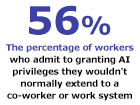
A majority (56 percent) of workers admit to granting AI privileges they wouldn’t normally extend to a co-worker or work system. These include sharing a password, API key or login credential (21 percent); personal or customer data (21 percent); or confidential corporate information (25 percent).
Furthermore, 55 percent of workers allow AI to perform actions autonomously, including processing payments and accessing emails and customer data, increasing the risk of rogue AI actions. Overall, 72 percent of organizations report experiencing a security incident involving an AI agent’s credentials or access in the past 12 months.
These are among the findings of a Dashlane-commissioned report that surveyed 3,000 knowledge workers and 800 IT and security executives across the U.S., U.K. and France. It found a striking disparity between security executives’ perceptions of AI risk and the considerable autonomy employees are giving AI tools and agents.
The report suggests the pace of AI adoption is straining IT and security teams, leading to the prioritization of speed over security. Sixty-one percent of IT and security leaders say pressure to move fast is one of the biggest barriers to securing AI agents. Among those facing pressure to implement AI, 57 percent say it has resulted in faster deployment with less security review.
As a result, 53 percent of IT and security leaders report that some AI tools are deployed without a prior security review, while 71 percent of organizations have granted AI agents standing access to internal systems or data.
“The challenge for security leaders is that the pace of change presented by AI and the potential consequences of misuse is unlike any other technology before it,” said Christophe Frenet, chief product officer at Dashlane. “Balancing speed and security has always been an issue front and center for enterprises, but with AI, the stakes of getting it wrong are much higher.”
The research also identifies a gap between corporate security teams’ confidence and the reality of AI adoption. While 89 percent of IT and security leaders are at least somewhat confident they know about every AI agent in use in their organization, 98 percent of organizations have discovered agents after deployment. Still, 28 percent of workers admit to using AI tools their employer does not know about.
Workers are extending more trust to their new AI colleagues than they would to human co-workers, without fully understanding what those tools can do with the permissions they’ve been given. Survey findings show that 48 percent of workers would lend their login credentials to a new AI tool after a week, compared with 42 percent who would do the same for a new human co-worker. More concerning, 52 percent of employees would comply if AI asked them to confirm their login credentials every day.
When an incident involving an agent occurs, determining responsibility can be difficult. IT and security leaders expect the blame to fall on them, with 69 percent saying they are responsible if something goes wrong. Only 11 percent fault the business unit that deployed it. Most IT and security leaders (84 percent) expect their budgets for AI agent oversight to increase over the next 12 months, while 79 percent expect their oversight workloads to grow.




Leave a Reply