

Written by: Haley Whalen, DMD
The term emergency dentistry covers a wide range of clinical cases. Sometimes it’s a small composite chip on an anterior tooth; other times it is an avulsed tooth with lacerations of the lip or tongue. For oral surgeons, it means fractured maxillas and facial reconstructions. For the general dentist, knowing how to treat each of these cases that walk through our door is one thing. Having the right materials on hand is another. You may have saved a tooth and gotten a patient out of pain, but sending them home with the wrong shade can still feel like a failure.
The Case
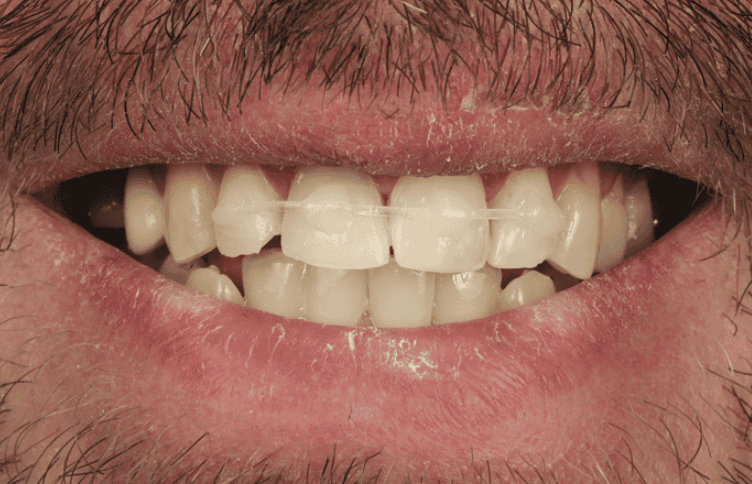
In this case, the patient fractured both maxillary central incisors after going over the handlebars of an electric scooter (Figure 1). By the time he contacted me, No. 8 was already testing non-vital, while No. 9 thankfully tested vital. He also had a small mesial incisal fracture on No. 7 and a distal incisal fracture on No. 10. Both central incisors had grade 1 mobility, and radiographs showed no root fractures.
Figure 1. Preoperative photo.
As general dentists, most of us approach every case the same way: gather data, evaluate the risks, develop a plan, and then hope for a good aesthetic result. The plan here was to restore Nos. 8 and 9 with large Class IV composites, splint the teeth with a non-rigid splint for 2 to 3 weeks (Figure 2), and complete root canal therapy on No. 8. I also told the patient that, depending on the final aesthetics and longevity of the composite on No. 8, he may need a crown in the future.
Figure 2. Non-rigid splint used for 2 to 3 weeks.
Choosing the Material
With a plan in place, the next decision was material and shade. In the preoperative photo (Figure 1), tooth Nos. 7, 9 and 10 matched A2 well and were uniform in shade with minimal translucency. The crown on No. 5 was brighter and more opaque than the neighboring teeth. Nos. 6, 11, and 12 were darker and closer to A3, and No. 8 was already turning dark gray.
An AACD-accredited dentist might treat a case this complex with a layered technique, using tints and a lingual matrix. As a dentist less than 5 years out of school, I was able to achieve a clinically acceptable result, and more importantly, a satisfied patient, with only 3 products.
I had used OMNICHROMA (Tokuyama Dental America) on many cases before, including Class V restorations, small incisal chips, and Class II restorations, but never on a fracture, or 2, this large. I knew a color-matching composite was my best option for matching the wide range of shades in this patient’s smile.
Technique
On No. 8, I placed both a deep bevel (shown in black) and a shallow bevel (shown in blue) in order to hide the transition line between tooth and composite (Figure 3). On No. 9, the fracture itself had created the deep bevel (shown in black), so I added only the shallow bevel (shown in blue). I then used OMNICHROMA BLOCKER to build a palatal shell on both teeth. Next, I filled the space between the palatal shell and the tooth with OMNICHROMA Flow to seal it and eliminate any potential voids. For the final layer, I used OMNICHROMA to build and shape the rest of each tooth.
Figure 3. Bevels used to hide the transition line.
Results
Tokuyama attributes OMNICHROMA’s ability to cover all VITA classical shades with a single composite to its Smart Chromatic Technology, which relies on uniformly sized 260 nm spherical fillers. In the final photograph, the shade match on Nos. 7 and 9 is nearly perfect (Figure 4). Just as impressive, the restoration blocked out most of the gray in tooth No. 8 and blended really well with the neighboring teeth.
Figure 4. Final photograph with perfect shade matches.
Why It Matters for Same-Day Care
With a traditional approach to same-day emergency cases like this, you need to have every shade on hand, which means paying to stock shades you may never use before they expire. Alternatively, you can get an excellent result with just 2 or 3 products, such as OMNICHROMA and OMNICHROMA BLOCKER.
As dentists, we need products that make our jobs easier without compromising clinical or aesthetic results. OMNICHROMA has become one of those products for me. Its shade matching, easy handling, need for me to keep a smaller inventory, and ability to save valuable chairtime when it comes to shade matching, are all aspects that matters most when the patient in your chair was not on the schedule that morning.
For more information, call (877) 378-3548 or visit tokuyama-us.com.
ABOUT THE AUTHOR
Dr. Whalen is a general dentist and the owner of Sun Dental Center in Las Vegas. She earned her Doctor of Dental Medicine degree from University of Nevada, Las Vegas. Before attending dental school, she earned her Bachelors of Science in metallurgical and materials engineering, and has a passion for dental materials and the science behind them.




Leave a Reply