


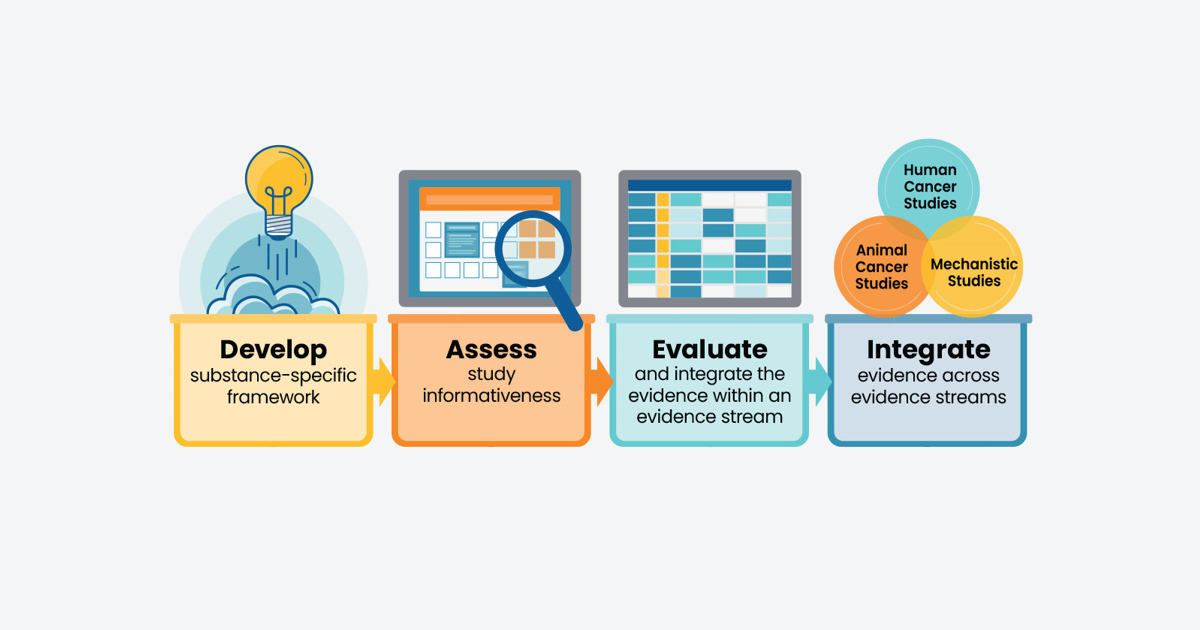
The National Toxicology Program (NTP) recently released a new handbook detailing the steps and processes it follows to determine which chemicals or exposures may pose a cancer risk to humans.
The Handbook on Methods for Conducting Cancer Hazard Evaluations explains how NTP systematically reviews scientific research to identify substances for inclusion in the Report on Carcinogens (RoC). The RoC listing of substances known, or reasonably anticipated, to cause cancer guides policies and regulations across the nation and around the world.
The resource captures the nuance and science of the systematic review process. (Image courtesy of NTP)
“The first step to cancer prevention is knowing what causes cancer,” said Ruth Lunn, Dr. P.H., who leads the Report on Carcinogens Group in the Division of Translational Toxicology at NIEHS. “This Handbook details the rigorous and scientifically supported methods we use to determine whether a substance is a cancer hazard and ensure consistency in our evaluations.”
According to Lunn, guidance and tools presented in the Handbook also provide a blueprint for researchers conducting other types of systematic reviews. (Photo courtesy of Steve McCaw / NIEHS)
Promoting transparency and confidence
The Handbook serves multiple audiences. Scientific researchers use it as a reference when evaluating the rigor of cancer hazard assessments provided in RoC monographs — the reports used to recommend substances for inclusion in the RoC. Industries and chemical producers turn to the Handbook to understand what processes were used to designate their products as potential carcinogens. Other experts in the scientific community rely on the tools and methods set forth in the Handbook to conduct their own cancer hazards assessments.
The largest beneficiary of the Handbook, however, are members of the public who seek transparency and confidence in the process to determine if substances or environmental exposures may cause cancer.
“People don’t want us just to say, ‘this causes cancer’ — they want to see that our assessments meet the most rigorous standards,” said Suril Mehta, Dr. P.H., an epidemiologist in the RoC Group who conducts cancer hazard evaluations. “The Handbook guides that rigor and also communicates it broadly.”
Mehta says the Handbook generates confidence that hazard assessments are rigorous, transparent, and supported by strong scientific evidence. (Photo courtesy of Steve McCaw / NIEHS)
Incorporating scientific advances
The new Handbook communicates advances in the systematic review process. Notably, there is an extensive discussion of innovative methods used to appraise the evidence from mechanistic studies — those that examine how a substance causes changes at the molecular and cellular levels that can lead to cancer.
The Handbook also discusses new features of the RoC monographs that present the conclusions of assessments. These enhancements include the following.
- Improved methods to incorporate evidence from different types of scientific research on cancer, not only from mechanistic studies but also from epidemiology inquiries and animal research.
- Incorporation of systematic evidence maps — visual tools that allow users to scope and explore information on the studies evaluating the substance.
- Enhanced tools and processes for assessing the informational value of individual studies and for judging if errors in design, conduct, or analysis of a study create a bias that casts doubt on the conclusions.
- Revised reporting methods for each evaluation that better describe how scientists concluded the likelihood a substance could cause cancer.
“There was a significant gap in information about how to interpret mechanistic data for cancer hazard evaluations,” said Whitney Arroyave, Ph.D., the support contractor lead. “We’ve taken what we’ve learned to create a much more detailed and structured process.” (Photo courtesy of NIEHS)
Up-to-date and evolving
Publication of this new information does not signal a sudden shift in the way researchers conduct assessments. Instead, it clearly documents how the methods for drawing conclusions have evolved and improved since the Handbook was last published in 2015.
“It builds on concepts that we have learned over the years and incorporated into our assessments,” Mehta said. “It adds structures and processes that we adopted since writing the previous Handbook and fills in information that was missing.”
Release of the latest Handbook also does not preclude further development and refinement of assessment strategies.
“We are always trying to incorporate the best practices and most rigorous methods,” Lunn said, “because it is important to have an accurate and trusted process for determining cancer hazards.”
Citations:
Lunn RM, Mehta SS, Jahnke GD, Wang A, Wolfe MS, Berridge BR. 2022. Cancer hazard evaluations for contemporary needs: highlights from new National Toxicology Program evaluations and methodological advancements. J Natl Cancer Inst 114(11):1441-8.
NTP (National Toxicology Program). 2021. Report on Carcinogens, Fifteenth Edition. Research Triangle Park, NC: U.S. Department of Health and Human Services, Public Health Service. https://ntp.niehs.nih.gov/go/roc15 (EndNote XML) DOI: https://doi.org/10.22427/NTP-OTHER-1003
(Douglas Murphy, Ph.D., is a technical writer-editor in the NIEHS Office of Communications and Public Liaison.)
