


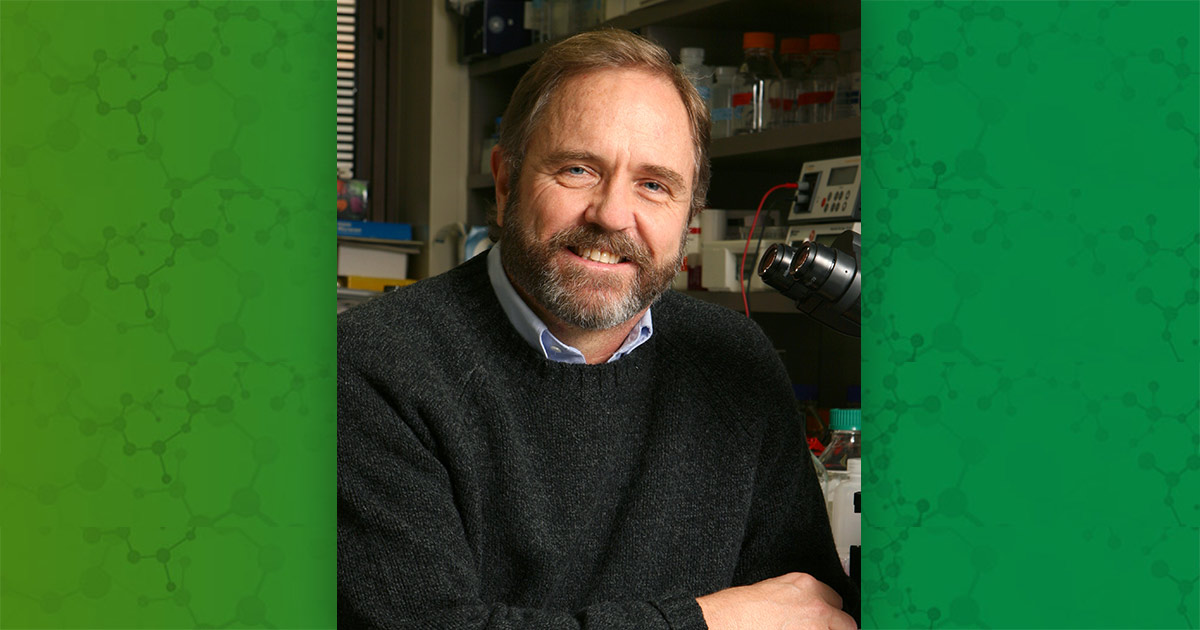
Perry J. Blackshear, M.D., D. Phil., has been busy since his retirement Jan. 1. The former head of the Post-Transcriptional Gene Expression Group, who joined NIEHS as Clinical Director and Senior Investigator in 1997, is winding down work in his lab, a process that will continue over the course of this year as he serves as an Emeritus Scientist and special volunteer.
Environmental Factor recently spoke with Blackshear about his journey from playing hockey in Minnesota to clinical research at NIEHS, and the mentors who inspired him along the way.
Before joining NIEHS, Blackshear was a professor of medicine and biochemistry at Duke University and an Investigator of the Howard Hughes Medical Institute. (Photo courtesy of Steve McCaw / NIEHS)
Environmental Factor (EF): Tell us about how your journey in science began?
Blackshear: I grew up in Mahtomedi, a lakeside town north of St. Paul, Minnesota. It was a pretty idyllic Minnesota childhood. Although my father, also Perry Blackshear, was a professor of mechanical engineering at the University of Minnesota and my mother was a pediatrician, I started college as a literature major.
When I was a sophomore, I was taking a particularly boring course on Yeats — who I ended up liking, by the way. I decided to look for something different, so I took the three-semester biology core curriculum. Instead of doing ordinary lectures, the professor brought in successful scientists from around the University of Wisconsin to talk about the highlights of their careers, what they were working on, and what they enjoyed about science.
Oliver Smithies, D.Phil., who in 2007 won a Nobel Prize for work he had started about that time, gave one series of lectures. He talked about science as a detective story, where there was a mystery that you needed to try to figure out. The way he described his science in those lectures was galvanizing to me, and I switched to zoology as a result. Smithies went on to join the faculty at the University of North Carolina at Chapel Hill in 1988, and he became a good friend and mentor later in life.
EF: What sparked your interest in environmental health?
Blackshear: As an endocrinologist, I was fascinated by the sudden increase in obesity and type 2 diabetes in the 1980s and 90s. This could not be due to a sudden change in the genetics of the population, leaving some aspect of the environment as the likely cause. At Duke University, I pursued diabetes research, and one project performed by Wi Lai, [Ph.D.] still an NIEHS staff scientist, involved screening for genes that were turned on in response to insulin. One had an unusually rapid response, and it did not look like anything in the current databases. We had discovered tristetraprolin [TTP], a protein that we later determined was involved with messenger ribonucleic acid [mRNA] stability.
EF: What did you learn about TTP at NIEHS?
Blackshear: We eventually found that TTP was an mRNA binding protein that could shut off the production of certain inflammatory cytokines. These cytokines are involved in innate immunity, the rapid response to many environmental stimuli. We found that removing TTP in mice led to an inflammatory condition, and that increasing TTP could prevent the development of other inflammatory disease models. We hope that increasing levels of TTP in humans might be effective against immune and inflammatory diseases, such as rheumatoid arthritis and psoriasis. These conditions, like diabetes, are on the rise and may be linked to environmental exposures.
Overall, this was a gratifying process — from discovering the molecule to figuring out how it works in cells, in animals, and at the molecular level. We’re now working with a local biotech company to try to develop compounds that increase TTP levels in humans as potential drug treatments for inflammatory conditions.
EF: What else should people know about your science?
Blackshear: Through the work of many hardworking fellows, graduate students, and collaborators, we moved from identifying a radioactive spot on an X-ray film to at least a partial understanding of the roles of TTP and its other mammalian family members in female reproduction, blood development, placental function, and inflammation. We also found members of this protein family in evolutionarily distant creatures, like yeasts, slime molds, and plants, and we know that these proteins play important roles in gene expression in some of these organisms. We have no doubt that their human equivalents are important in many aspects of human physiology. Our hope is that this knowledge can eventually lead to treatments for human disease.
EF: Why was it important to develop patient registries as part of clinical research at NIEHS?
Blackshear: The callback feature of the Environmental Polymorphisms Registry, which has since become known as the Personalized Environment and Genes Study, was rare if not unique at that time. People from the community had donated DNA and completed questionnaires about their environmental exposures. If researchers discovered specific DNA variants of potential interest, the subjects could be called back for potential follow-up clinical and laboratory evaluations, possibly linking their DNA changes to clinical traits and conditions.
EF: What do you most enjoy about research and what’s on the horizon for you?
Blackshear: Coming up with experiments and interpreting the results are all, I think, very creative and gratifying endeavors. And when you discover something that’s new to science, it’s still a thrill.
In retirement, I’m hoping to get back on skis, to the extent the titanium in my joints permits. I very much enjoy bird watching, kayaking, cycling, and walking. And playing with my two new grandchildren.
(John Yewell is a contract writer for the NIEHS Office of Communications and Public Liaison.)
