

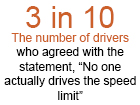
Speeding has become the norm for many drivers, according to a new report from the American Automobile Association (AAA) Foundation for Traffic Safety (AAAFTS). The research reveals that three in 10 drivers agreed with the statement, “No one actually drives the speed limit.”
While most drivers agreed that posted speed limits are appropriate, many also considered driving 10 mph over the limit acceptable, and nearly half believed keeping up with traffic is safer than obeying the posted limit.
“Findings from this research show that some drivers in the United States view speeding as a normal part of driving,” said Dr. David Yang, president and executive director of the AAA Foundation for Traffic Safety. “When people take cues from surrounding traffic instead of following posted speed limits, it creates a culture that makes crashes more difficult to prevent and roads less safe for everyone.”
The findings suggest many drivers aren’t speeding simply to save time—they’re often convincing themselves that speeding is the right choice for the situation. More than 30 percent of drivers admitted to speeding to get around slower drivers. Additionally, 25 percent sped to reach their destination faster, and 21 percent did so to avoid holding up traffic.
Meanwhile, 79 percent of drivers said they would slow down to avoid getting a ticket, while 72 percent would put on the brakes to avoid being in a crash. Sixty percent said they would slow down for bad weather.
The report also found that drivers generally prefer countermeasures that encourage safer speeds over those that physically force them to slow down. Drivers expressed strong support for increased police presence in areas with a history (87 percent) or potential (88 percent) for speed-related crashes, while roughly seven in 10 supported automated speed cameras in those locations.
Drivers also viewed advisory Intelligent Speed Assistance (ISA)—in-vehicle warnings or alerts when a driver exceeds the speed limit—more favorably than technology that automatically limits vehicle speed. Although more than nine in 10 drivers believed speed humps are effective, fewer than half supported installing them in their own neighborhoods. Support for ISA decreased as the technology became more restrictive, particularly if drivers could not override the system.
“There is no silver bullet for addressing traffic safety risks caused by speeding,” Dr. Yang said. “Understanding which strategies drivers are most willing to adopt can help policymakers and safety professionals develop interventions that are both effective and publicly acceptable.”




Leave a Reply