

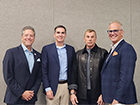
(L to R) Speakers at The AI Revolution panel included Howard Purcell, OD, FAAO, Chris Wroten, OD, Carl Spear, OD, MBA, FAAO, and Scot Morris, OD.
ANAHEIM, Calif.—During the American Academy of Optometry’s annual meeting, Academy 2026 Anaheim, Jobson Optical Group hosted “The AI Revolution: Reimagining the Optometric Identity in the Age of AI,” a panel that brought together leading voices in optometry to discuss how artificial intelligence is reshaping clinical care, education and practice operations. Moderated by Scot Morris, OD, co-editor of Jobson’s AI in Eye Care, the discussion featured Howard Purcell, OD, FAAO, president and CEO of New England College of Optometry; Chris Wroten, OD, Bond-Wroten Eye Clinic; and EssilorLuxottica’s Carl Spear, OD, MBA, FAAO.
During the panel, the experts agreed that AI is pushing optometrists away from being primarily data gatherers and toward becoming more strategic decision-makers. Dr. Morris described a future in which history-taking and some diagnostic steps may increasingly happen outside the exam room, with optometrists serving more as “navigators” than gatekeepers.
The panel outlined three waves of AI adoption in eyecare including the following:
- Operational (where we are now): Administrative automation, ambient documentation, pretesting and coding/billing.
- Clinical (1-3 years from now): Predictive risk modeling, biomarker analysis and AI-driven clinical decision support, such as confidence scores for glaucoma.
- Interventional (5+ years from now): Autonomous diagnostic agents and AI-guided interventional procedures.
During the AI Revolution panel, hosted by Jobson, optometry leaders discussed how AI will reshape clinical care, education and practice operations—and redefine the optometrist’s role.
In education, Dr. Purcell said optometry schools are under pressure to decide what should still be taught in a four-year curriculum as AI makes information more accessible. He pointed to new approaches such as custom AI bots for students and “digital twins” that can simulate disease progression.
Dr. Wroten said AI can improve efficiency, but the doctor’s value remains in interpretation and patient communication. Dr. Purcell noted that soft skills and human connection will continue to distinguish optometrists in practice.
The panel also emphasized AI’s potential to improve access to eyecare services in underserved areas. Dr. Spear noted that many counties in states such as Texas and Florida have no eye doctor, while Dr. Morris said he is the only OD in six counties.
Despite the promise, the speakers said the profession must overcome fears of change and replacement. Their message: AI will not replace optometrists, but it will change what makes them valuable.
For the full article, and more live coverage from Academy 2026 Anaheim, check out the October 2 edition of AAO NOW, a daily e-newsletter published by Jobson Optical Group in conjunction with the American Academy of Optometry. Other editions can be found here for September 30 or here for October 1.




Leave a Reply