

Today marks the 25th anniversary of the September 11 attacks. With New York City home to Jobson Optical Group’s corporate headquarters during that time, this day remains deeply personal for many of us as we witnessed the attacks firsthand through the windows of our Soho office. Located 12 blocks north of the World Trade Center towers, Jobson occupied the ninth and 14th floors in that building. Both floors had windows facing both towers from the north with unobstructed views.
September 11, 2001, began as a beautiful, sunny day with crystal blue skies as the backdrop. It was a Tuesday, and along with thousands of other New Yorkers, I headed out on the morning commute to the office. I had just begun my career at Jobson a year earlier as marketing coordinator and editor of Planet Jobson, our corporate newsletter. That week, I was asked to fill in at our reception desk, which meant I had to be in the office at 8:30 a.m.
As I started the day answering calls and attending to my daily tasks, I never would have imagined the events that transpired that day, and how it would forever change our lives and our city. So many of us still have vivid memories from that day along with our own stories to tell, especially for my Jobson colleagues who were present that day.
Some of us were on location at the office, while others were en route but had to turn back home. On the occasion of the 25th anniversary of what we now know as 9/11, allow us to share our experiences and recollections from that day. As we remember and honor all the civilians and first responders who were lost that day, we hope you take a moment to read this special collection of stories contributed by Jobson team members, both past and present.
–Christine Yeh, Senior Executive Editor, 20/20
One Man Was Walking Alone…Covered in Dust
Marge Axelrad, Editorial Director Emeritus, Vision Monday
I always got to Jobson’s office at 100 Sixth Avenue in Soho around 9:30 a.m., so I was just leaving my apartment building up on East 64th Street that morning about 8:55. When I got downstairs the doorman was just ashen and told me to go back upstairs and turn on the TV. As I was catching up on broadcasts of the first tower downtown, I watched as NBC-News’ Katie Couric broadcast from the roof deck with the buildings downtown behind her as a second plane became visible and turned into the 2nd tower. I felt an electric charge and realized this was ‘intentional.’ I also quickly called my family—everyone was OK, just initially reacting in disbelief and in shock.
Landlines had to be used for phone calls as mobile phones then were starting to get jammed up; I called the Jobson N.Y. office and needed several tries to get through. I learned quickly enough that everyone there was in shock as well, and most onsite, just about 12 blocks north of the WTC, were ok at that time, stunned as we all were.
It was not possible to go downtown for days. My brother-in-law worked in midtown on the day of the attacks, and I was able to get my car to him, so that he was able to drive home to the family north, out of the city, and he transported a few people from his office to other car rental spots as well.
As I waited for him on the corner of First Avenue and 64th Street, there were hundreds of people walking to get themselves home over bridges east and north of the city. One man, six-feet tall, in an overcoat, suit and tie, hat with a briefcase was walking alone, covered in dust, and it was clear he had walked all the way uptown from the Trade Center area. He was in shock. It’s an image forever etched in my mind.
Two nights after the 9-11 explosion, the city was still very quiet. At 2:00 a.m. there was a huge boom, which, afterward, we realized was thunder from an approaching storm. But every light in the nearby buildings turned on when it happened, and I saw people at their apartment windows looking out, wondering what that noise was, could it have been the nearby 59th Street Bridge? The UN building? We were very afraid that something ‘else’ had happened.
For days there was traffic blocked near the major hospitals as nurses and emergency staff ‘waited’ for people to arrive, there to help if needed. Incredibly poignant and sad. The city was literally ‘quiet’ for days. People were gentler with each other, it was stunning.
Once I knew that family and friends and the VM team was ‘OK’, we swung into action fairly quickly. It was hard to communicate via email and landlines but we did it. We all immediately wanted to reach out to people in as many sectors of the eyewear/eyecare business as we could, because we knew this was not just a New York story. It was an American story, a global one as well.
Our team dove into action to not only hear how people and businesses were coping, but to also be a center of information so that relief and rehabilitative efforts could be coordinated.
People dove into action and The Vision Council, along with every company, association and major group in the industry, had started to regroup and lend a hand to help people cope with the ‘What’s Next?’.
With Vision Expo West scheduled to take place two weeks later, we understood that The Vision Council and Reed Expo at the time had to make the decision to cancel the show and so we also jumped in to help people consider how to move their businesses forward after that.
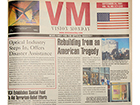
There were two special issues of Vision Monday (we were a print newspaper at that time); trying to give people room to share stories and share thoughts about their next moves were paramount. Our issue, “Rebuilding From an American Tragedy” came out of that, and for weeks and months afterwards, we and others just moved ahead one little step at a time.
We all learned about the threads of our relationships and connections spanning all of us with colleagues, industry partners and VM readers in the U.S. and around the world in the aftermath of such an incredible, shattering experience.
–Marge Axelrad, Editorial Director Emeritus, Vision Monday
A Workday Conversation, Then a Plane Passing Overhead
Marc Ferrara, Consultant to the President of Jobson Optical Group
I’ll never, ever forget that day. While it started as a beautiful September morning—bright sunshine, clear blue skies and very pleasant humid-free temperatures—dark, ugly clouds would soon change the sky scape. I was having an early workday conversation with our CFO, John Orr, when we both heard a very loud plane pass overhead, seemingly right above our building. We both commented that it seemed odd for the plane to be flying so low, but it passed quickly, and we went back to our discussion of the year’s financial outlook.
Within a brief moment, less than a minute later, we heard other staff members, whose workspaces faced south to the twin towers, suddenly shouting things we couldn’t fully understand. So we walked over to that end of our office, and a little more than a mile south of our office, we could see a gaping hole in the North Tower, with flames bursting out of what was now a hellish inferno.
At the point, trying to absorb what we were seeing, we all assumed a pilot had suffered a heart attack and accidentally flew his jet into the Tower. Horrified, we watched with disbelief and switched on radios to see if we could learn more. Little information was available, other than the obvious tragedy we were witnessing. However, a mere 17 minutes later, we watched as the second plane crashed into the South Tower. All of us, now fully in shock, felt convinced we were witnessing intentional—not accidental—catastrophe. We continued to stare in total disbelief as both towers burned, still unclear what had actually occurred. The only news or next steps we could glean was minimal, and city officials advised we stay in our offices until they knew it was safe to go outside into the streets. Eventually, we saw the towers crumble from the intense heat and destruction caused by the two jet planes, with their full fuel tanks, turned into devastating weapons.
After shock, everyone’s overriding state was one of confusion. Who would do this? What was the ultimate game plan? What do we do next? Communication tools were largely useless. We learned that Manhattan was closed to any incoming traffic, cars or trains. All planes were grounded.
I was now driven by an overriding concern of how I could get home to my family, who were 30 miles east on Long Island. A group of us who all lived east of the city learned we could walk over the 59 Street Bridge to Queens and possibly catch a commuter train or subway to take us further east. So that’s what we did, walked the six and half miles to the bridge, crossed the span all the while looking to our right and watching the smoke rise from the collapsed, burning towers to the south. We were not alone. Thousands of others, making the same forlorn trek home, joined us, all determined to get to their friends and families.
9/11 was a Tuesday, and the area surrounding our office in Manhattan was closed until Friday morning. That day, September 14, I was able to get back to the office as the cordoned off area was moved south of Canal Street, a block below our location. It was eerie traveling to the city with so few other commuters, and once I emerged from the subway, I could still smell the burning embers of the crumbled towers.
It took me over a decade to visit The 9/11 Memorial in lower Manhattan. I still feel the shock of that day, and don’t believe that will ever go away.
–Marc Ferrara, Consultant to the President of Jobson Optical Group
An Incident at the Station Ahead
I remember it being hot that morning. I was running late for work and annoyed that my train had stopped two stations short of the office and wouldn’t go any further. The announcement said we weren’t going to move anytime soon because of “an incident at the station ahead.” So I decided to walk.
Coming out of the station, I remember seeing the familiar sight of the Towers as I walked south. That morning, however, one of them was billowing thick black smoke. I remember thinking “Ah, fire. So that’s what the ‘incident at the station ahead’ meant. How did that happen? Better yet, wonder how they’re going to put that out?” without considering for even a moment that it might be anything beyond an “ordinary accident.” If there is such a thing.
As I continued toward the office, I remember the unusual silence around me: People just standing, staring up, pointing, muttering. Quite unnatural for New York City. Well, maybe not the muttering.
Arriving at the office, I remember the sight of coworkers rushing toward the windows that faced the Towers, talking in frantic, animated tones. I still didn’t know what was happening, so, curious to find out, I joined them. At the window, I remember seeing the second Tower billowing the same thick black smoke as the first. I thought: one tower on fire, yes, but both? That seemed improbable. Then someone explained what had happened. Even then, collapse? The thought never even crossed my mind.
But then they did.
First the South, then the North half an hour later. I remember watching each of them fall. Like a special effect out of a movie. Seemingly in slow motion, I watched but did not process what I was seeing. Then realization. Then a draining sensation that traveled from the top of my head down to the tips of my toes. A sinking feeling. Quite hard to forget.
I remember the feeling of hollowness that set in after that. For the briefest of moments, reality became hazy and distorted. Time froze. Both ears rang loudly. Then just as quickly, everything came rushing back.
Around the office, I remember co-workers beginning to silently sob, some openly cry, and one or two wail. The rest of us were just confused, numb and in shock. No one knew what to do, or even how to react. We were told to go home.
Outside, I remember that the streets and avenues around the office, normally filled with afternoon traffic, tourist, office workers and ordinary people going about their Tuesday routine, were already unnaturally silent, nearly deserted.
Then from the south, I remember the sight of people appearing, walking north, covered in and trailing clouds of ash and dust. Dazed, disoriented and wide-eyed. Individuals hobbling like zombies, couples clutching to each other, groups holding on to one another.
A group of us wanted to do something for them. I remember the helpless feeling of not knowing how. We attempted to volunteer at nearby St. Vincent’s Hospital to help out in any way, do something, anything, but were turned away. No one seemed to know what was needed. Just like the rest of us, everyone was just trying to figure out what to do in a situation none of us had ever experienced.
I remember that for days, weeks and months afterwards, the city felt completely unfamiliar. We were all hyper-alert, hyper-vigilant, constantly looking up, as though the smallest sound or unusual movement might mean something was about to happen. We watched the people around us while feeling that we were being watched in return. Some of that still lingers to this day.
I remember September 11th ending that day. But the world changing forever did not.
–Pierre Gascon, former Director, Network & Systems Services, Jobson Optical Group
Shocking to See the Towers Gone
Andrew Karp, former Group Editor, Lenses & Technology, Vision Monday and 20/20 magazine
I wasn’t in the office that day because I had to take my parents to a doctor’s appointment. I was in touch with our team throughout the crisis, but couldn’t return to the office for 2 weeks, since lower Manhattan was off-limits for everyone but residents.
My wife Debbie came with me to the Soho office to conduct group therapy sessions with Jobsonites who had been in the office during the attack and had seen the towers in flames, since we had a birds eye view of them from our 14th and 8th floor offices. Since Vision Expo West was canceled, we scrambled to produce a promo kit that vendors could send to attendees.
Marge Axelrad and I, and Dennis Murphy had been to the World Trade Center about a week before to see a concert on the plaza. It was so shocking to see the towers gone. They were a fixture in our lower Manhattan landscape.
–Andrew Karp, former Group Editor, Lenses & Technology, Vision Monday and 20/20 magazine
Endless Posters of the Missing
Iris Johnson, former 20/20 Art Director and current Senior Art Director for Jobson/WebMD
Being in NYC on 9/11 was an intense and surreal experience. So much seemed unbelievable, like I was having a bad dream, and yet it was all happening. The news coverage couldn’t convey what it felt like to watch the buildings collapse in front of you and walk uptown with people covered in ash.
On that day, I still remember the perfectly blue sky. I walked to work, and I was marveling at the beautiful weather when the firetrucks and police cars started flying past me on their way downtown. Perfect September weather always reminds me of 9/11 now. I remember watching out my window at work and feeling a stab in my chest when the first tower collapsed.
I remember walking uptown when the second tower collapsed, passing lines of people at pay phones, trying to contact their families. My apartment was right down the street from St. Vincent’s Hospital, and there were TV crews waiting for ambulances to arrive with injured people, but no ambulances came. The days and weeks after were hard—I read the memorials in The New York Times with my morning coffee and cried. I went jogging with soot floating in the air (what was I thinking) and passed endless posters of the missing. It was a difficult time, and I almost left New York.
I will never forget what I went through and what this city went through. I am more cautious now about certain situations like flying and being in crowds. I’ve lost a certain optimism about the world that I had before 9/11—now I know that terrible things can and do happen, even the most unimaginable things. And I still feel that raw sadness when I think about that day and all those people who lost their lives.
–Iris Johnson, former 20/20 Art Director and current Senior Art Director for Jobson/WebMD
A Picture, a Name, a Number That No One Would Ever Call
Judith Michael, former Senior Vice President, Business Operations, Frames Data
On September 11, 2001, Jobson’s offices were located on Sixth Avenue, one block north of Canal Street and one mile north of the World Trade Center. I arrived as usual just after 8:45 a.m. and as I started up the subway steps I was struck by the sounds of many sirens and the clip-clopping of horses’ hooves. I wondered why there would be so many mounted police in the area. I started walking north to the office and saw everyone ahead of me turning south and pointing, looking alarmed. When I too, turned around to face south, I saw smoke billowing from the North Tower of the World Trade Center. People on the street and in our building’s elevator were sharing the news that an airplane had stuck the North Tower at 8:46, just minutes before.
Much of the Jobson staff had gathered in the accounting department, since it had large windows facing south with an unimpeded view of the Twin Towers. As we stood there gaping, our CEO said “Look, there’s another plane coming!” Then we saw a commercial jet make a sharp turn and crash into the South Tower. Everyone started shouting—we now knew this was not an accident but something far worse.
People were then concerned that the Towers would collapse, but Bob A. Amato, Jobson’s founder and owner, ever the optimist, told us that no, the towers had been constructed to withstand any disaster. Many of us disbursed back to our desks to make phone calls and listen to the radio—this was before social media and widespread internet access. Some coworkers with south-facing windows were horrified by the sight of people jumping from the Tower windows. At 9:59 a.m. the radio announced that the South Tower was collapsing, and we rushed again to the south-facing windows. There was dust and debris pouring north up Sixth Avenue and people running just barely ahead of it, trying to avoid the debris and destruction.
Jobson’s owners, the Amatos, told everyone they could shelter in place or head for home, whatever they thought best. Like many others, I wasn’t sure what to do—where would the terrorists strike next? I’m embarrassed to admit that when I heard that the Pentagon had been targeted, I thought “Oh thank goodness, they’ve left New York.”
By then cellphone servers were so overwhelmed that calls could only be made on landlines, tunnels and bridges were closed to traffic (except some foot traffic), and subways were no longer running. I ended up walking uptown for many blocks, getting on a very crowded bus for a time, and even squeezing into an uptown cab with strangers for a while. I finally made it to 187th Street where my daughter was being dismissed from her fourth day of kindergarten.
The office remained closed until the following Monday, because there were lockdowns with restricted access to Jobson’s address unless you could prove residency. Our CTO had tried to gain access to the server a few days earlier, but was turned away at 14th Street. The morning of September 17 I made a harrowing walk to the office from the Houston Street subway stop, through fairly deserted streets. Every lamppost and wall space and stop sign was covered with posters: “Have you seen this person?” with a picture, a name and a phone number that no one would ever call.
The office was sparsely populated, but since I was the VP of Manufacturing, I discussed with Bob S. Amato how we could implement the “Show in a Box” concept, since Vision Expo West had been canceled on September 14, following the shutdown of U.S. aviation systems and widespread travel disruptions. The “Show in a Box” delivered trade show coverage directly to the optical community by bundling product launches, frame trends, and seminar summaries to support the industry business continuity. I believe there are still some copies in the Vision Monday archives.
–Judith Michael, former Senior Vice President, Business Operations, Frames Data
Hearing a Plane, Fearing It Would Happen Again
Nancy Ness, former VP Marketing, Jobson’s Retail Optical Group
I never actually got to the office that day. I was driving in, sitting on the New Jersey Turnpike and could see smoke coming from one tower. I couldn’t imagine how a plane could accidentally hit one of the towers, not thinking for a moment what the reality was. I immediately called the office and spoke to one of my marketing team members. She was crying hysterically and said that it wasn’t an accident, it was a terrorist attack and that everyone was leaving the building.
My most vivid memories were in the days that followed. Our office was in the frozen zone and closed for weeks. Once we were finally allowed back in, I remember walking on the sidewalks and anytime you heard a plane, you were afraid it could happen again. A white dust covered my car, parked right near our office. One of the restaurants we would have lunch at often was turned into a place for first responders and volunteers to go for a hot meal. And, a beautiful September day in NYC with a crystal clear blue sky, will always be an instant reminder of that day.
I think it brought our already close Jobson team, even closer together. The whole experience contributed to a stronger love and support of NYC, and the resilience of its people.
–Nancy Ness, former VP Marketing, Jobson’s Retail Optical Group
There Is No Forgetting
James Spina, former Editor in Chief, 20/20 magazine
I heard the first plane hit and watched as the second plane literally turned toward the south tower and hit with a flaming explosion. I now think about this literally every time I see a jet liner.
I watched with horror as jumpers leapt to their deaths. On a surrounding terrace to our Jobson office, I saw the ash sweep through the mile maze of streets right up to the edge of Canal Street a block away. Sales rep John Carney and I stared at an empty sky wondering when the next flights would zero in on surrounding buildings including ours. We witnessed two fighter jets but had no idea if they were ours or enemies.
I left the office shortly after the first tower collapse, horrified that many thousands were dead. Sales associate and friend Chris Rice and I started walking uptown joined by a somber parade of men and women covered in ash. We tried to give blood at Bellevue Hospital but were told to move on by police recruits from the nearby academy.
Although petrified that another plane would hit the CitiCorp building, we decided to get on the subway for Queens at Lexington and 53rd Street. We made it to my apartment in Kew Gardens where my wife was just one month short of giving birth to my son Gram, who will be 25 on October 3.
He was born at Saint Vincent Hospital those few weeks later. My wife Kristin’s hospital room looked out on the still smoldering ruins of Ground Zero. When we drove into the city with Kristen in labor, we were stopped by armed guards at the Midtown Tunnel. We were waved through when the guard looked in and saw Kristen pregnant and in obvious labor. Our city was a war zone.
There is no forgetting. I was witness to horror and resolved to strength for me, my wife, my son and those who stood by me at that window, witnesses to a nightmare… a nightmare I still have 25 years later on numerous occasions.
Gram is truly a 9/11 kid. When we visited the makeshift memorial about seven years after the day, the new building was rising just as the towers once did in plain sight as I moved through Queens College in the late ’60s and early ’70s.
As 7-year-old Gram studied a mural in the exhibit he realized for the first time that it wasn’t fighter jets that hit the building. It was passenger jets. “But Dad… That means they were just like you and me. Ordinary people. Ordinary people crashing into ordinary people. Dad. That doesn’t make any sense.”
Exactly Gram. But we need to try and make it make sense so it doesn’t happen again.
And THAT’s what we need to keep trying to remember.
–James Spina, former Editor in Chief, 20/20 magazine
It Felt Like a Bad Dream
Christine Yeh, Senior Executive Editor, 20/20 magazine
The reception desk where I sat that day shared a wall with our accounting department, which had windows facing both towers from the north. Through this wall, I heard the audio of my colleagues’ initial reactions to that morning’s events, and through the windows, I watched all of it unfolding seconds after each occurring event. I recall running back and forth between my desk and the accounting department when the planes first struck the towers. Part of me didn’t want to step away from the window, but the other part knew I should continue to answer the phones as calls began flooding in. I was not in front of the window when the first tower began to collapse, but I remember hearing my colleagues screaming with a level of horror that I will never forget. When I ran back to look out the window and saw the tower collapsing surrounded by plumes of dust clouds and smoke, I completely lost it and began to cry. We were already confused and shocked from the towers being struck, but nobody saw the collapse coming. It was emotionally chaotic in the room. Some were inconsolable from sadness and shock, some were frightened realizing we were being attacked, while others were concerned about loved ones working in buildings near the towers. After the second tower collapsed, many of us prepared to go home.
The rest of the day felt like a bad dream. With the subways temporarily shut down, I walked 40 blocks north to midtown to meet up with my sister. We jumped on the subway to head home to Queens once some lines were up and running again with limited service. I still remember how eerily quiet and somber the mood was on the subway. No one said a word, but we were all feeling the same thing. When I got home and turned on the TV, I saw the videos replaying of the towers collapsing and even though I had already seen it happening live, I could not stop crying. My house in Queens was only a few blocks away from the Long Island Expressway (I-495), which ran east and west between Long Island, Queens and Manhattan. That night and for the next few nights, all I heard were nonstop sirens from emergency vehicles from all over Long Island rushing toward the city to help. I cried myself to sleep those nights.
The following week, our office re-opened, though it was optional to return to work. I made the decision to go because I needed to feel connected to my city and in solidarity with those who were at Ground Zero helping. I remember coming out of the subway by our office and smelling a smoky stench and realizing it came from Ground Zero. For weeks and maybe even months, that smell lingered. I also remember seeing and hearing fighter jets patrolling the skies over the city and thinking how surreal it was. I remember being in a car driving into Manhattan and seeing the city skyline forever changed. It took a long time to accept this change, especially when all your life, in movies, on TV and in person, you saw that famous skyline with the two towers standing tall with the Empire State Building.
In the weeks that followed, it was hard watching the news and seeing the continued devastation, and the reality setting in that not many people survived. What gave me some sense of peace was the unity I witnessed from our city, and how everyone came together. My colleague Andy Karp, who many years later I would work closely with when I joined the 20/20 editorial team, invited his wife Debbie to our office to conduct grief counseling for those who needed it. I found out in the weeks that followed a Jobson colleague (former 20/20 production manager) lost her fiance. I also found out that a former classmate from college lost her life, as well as a friend of a friend who I had met several times. Knowing at least three people who lost their lives that day showed the sheer magnitude of how much devastation that day brought. A few months later, I began to gather stories from my colleagues, allowing them to share their experiences in our corporate newsletter Planet Jobson. Working on those stories brought me even closer to many of colleagues, as we will always share a special bond connecting us to that day.
To this day, I can’t speak about my experience from that day without getting emotional and tearing up. I don’t mind sharing my experience, but the emotions are still fresh and raw. I don’t think that will ever change. I try to avoid social media on the anniversary each year because seeing photos and videos of the towers in flames and collapsing still triggers me. I don’t have a fear of flying but seeing and hearing planes fly overhead sometimes still give me a moment of anxiety or panic.
For many years, I continued working at the same Soho office building where I witnessed that day’s events. Construction began a few years later on One World Trade, and as I began to see the progression of this building, sometimes it made me sad, but it also became an everyday reminder of hope and rebuilding. When the building opened to the public along with the reflecting pools where the footprint of the towers once stood, I did not have the desire to go visit because I knew I would feel overwhelmed. For many years, I avoided it, even though I saw the building almost every day. In April 2016, during Vision Expo East, an event was held in collaboration with Marchon Eyewear and the Optical Women’s Association for its Star Awards. This event also celebrated 20/20’s April issue which featured a five-cover partnership with Marchon. The event was held at the top of One World Trade. I remember feeling a little anxious knowing that I will be setting foot there. But the party was a beautiful celebration of 20/20 and our optical industry—it helped me let go of some of the sadness I was holding on to. It remains one of my most cherished career highlights to date because that night, we became a part of my beloved NYC skyline.
–Christine Yeh, Senior Executive Editor, 20/20 magazine




Leave a Reply