

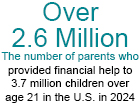
A new report from the U.S. Census Bureau reveals U.S. parents provided $26.6 billion in financial support to adult children in 2024. More than 2.6 million parents provided financial help to 3.7 million children over age 21, according to the U.S. Census Bureau’s 2025 Survey of Income and Program Participation (SIPP).
This does not include money parents spent supporting adult children living at home. In 2024, 58.3 percent of men and 56.4 percent of women ages 18 to 34 lived with their parents. More than 72 percent of parents supported one adult child, while 18.8 percent provided support to two and 8.6 percent to three or more.
Report summary author Liza C. Valle, an analyst at the Census Bureau, noted that parents who financially supported their adult children differed demographically from other parents age 36 and older. They were less likely to be born in the United States (70.3 percent vs. 77.5 percent) and more likely to:
● Be men (55.7 percent vs. 46.1 percent).
● Be employed (68.3 percent vs. 58.0 percent).
● Have a bachelor’s degree or higher (46.0 percent vs. 36.8 percent).
● Be divorced (20.8 percent vs. 14.3 percent).
● Have earned income from bonds or stocks (21.8 percent vs. 16.8 percent).
The report noted that parents financially helping adult children had a higher median annual income than those who did not provide support ($63,440 vs. $41,930).
“This might be explained by the presence of larger households among those who did not support adult children—around 48.3 percent lived in households with three or more people compared to 31.3 percent of those who supported adult children,” Valle said.
In 2024, around 11.4 million people in the United States gave $78.1 billion to 19.0 million people living outside their households. In addition to supporting adult children, they provided financial assistance to 7.2 million parents ($20.2 billion), 5.8 million relatives other than parents and adult children ($22.8 billion), and 2.4 million nonrelatives ($8.4 billion).
Nearly two-thirds (64.6 percent) of providers gave financial support to either parents or adult children, consistent with other findings showing these two groups are the primary recipients of financial assistance, the report concluded.




Leave a Reply