

Police departments are increasingly relying on AI to enhance law enforcement. A new report from the National Policing Institute (NPI), “The AI Adoption Strategy Gap in Policing: An Unmet Need With Real-World Consequences,” reveals that artificial intelligence (AI) has already arrived in American law enforcement, but the governance, training and accountability structures needed to use it responsibly have not kept pace.
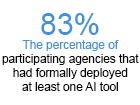
The report finds that 83 percent of participating agencies had formally deployed at least one AI tool, and every agency represented had some form of AI presence. Additionally, 44 percent had done no AI-specific training for any personnel, even as officers and deputies use AI on personal devices and accounts, with or without agency approval.
More than 60 percent had designated a person or committee for AI governance, but the report finds that designation alone does not answer the harder questions: Who approves specific use cases? What does the audit trail require? And what happens when an AI output is wrong?
“What’s missing is not prohibition, not regulation against the use of AI, but a responsible framework for how to prepare your agencies to better leverage AI for more efficient and effective public safety,” said James Burch, president of the National Policing Institute. “We’re talking about how you prepare your governance processes, your accountability processes, your staff, and how you engage the community early and consistently in this process.”
The report argues that law enforcement doesn’t lack guidance on what AI can do. Decision frameworks for evaluating specific tools are emerging. What the field lacks is a strategy for building organizational readiness for AI adoption. This includes data infrastructure, governance, workforce literacy and community trust, which must be in place before any tool is responsibly deployed.
The report finds 76 percent of executives believed their employees were enthusiastic about AI adoption, compared with only 31 percent of employees who actually reported enthusiasm. Further, nearly one-third of employees reportedly admitted to actively opposing or sabotaging their organization’s AI strategies.
The report points to models the field can learn from: Georgia’s state-run Innovation Lab, which requires ethics training before any AI solution reaches production; the United Kingdom’s newly launched PoliceAI center, a $95 million national investment testing and scaling AI across all 43 police forces in England and Wales; and the San Diego County Sheriff’s Office, which built more than a decade of in-house AI capability rather than relying solely on vendors, producing tools such as a deputy-built interview transcription system with projected annual costs under $100,000.
“No American law enforcement agency has—to our knowledge—developed a proven, replicable accountability framework for AI that can serve as a field-wide standard,” the report states. “The UK’s National Police Chiefs’ Council has published a governing covenant with six principles every force must follow: lawful, transparent, explainable, responsible, accountable and robust. American law enforcement has no equivalent.”




Leave a Reply