

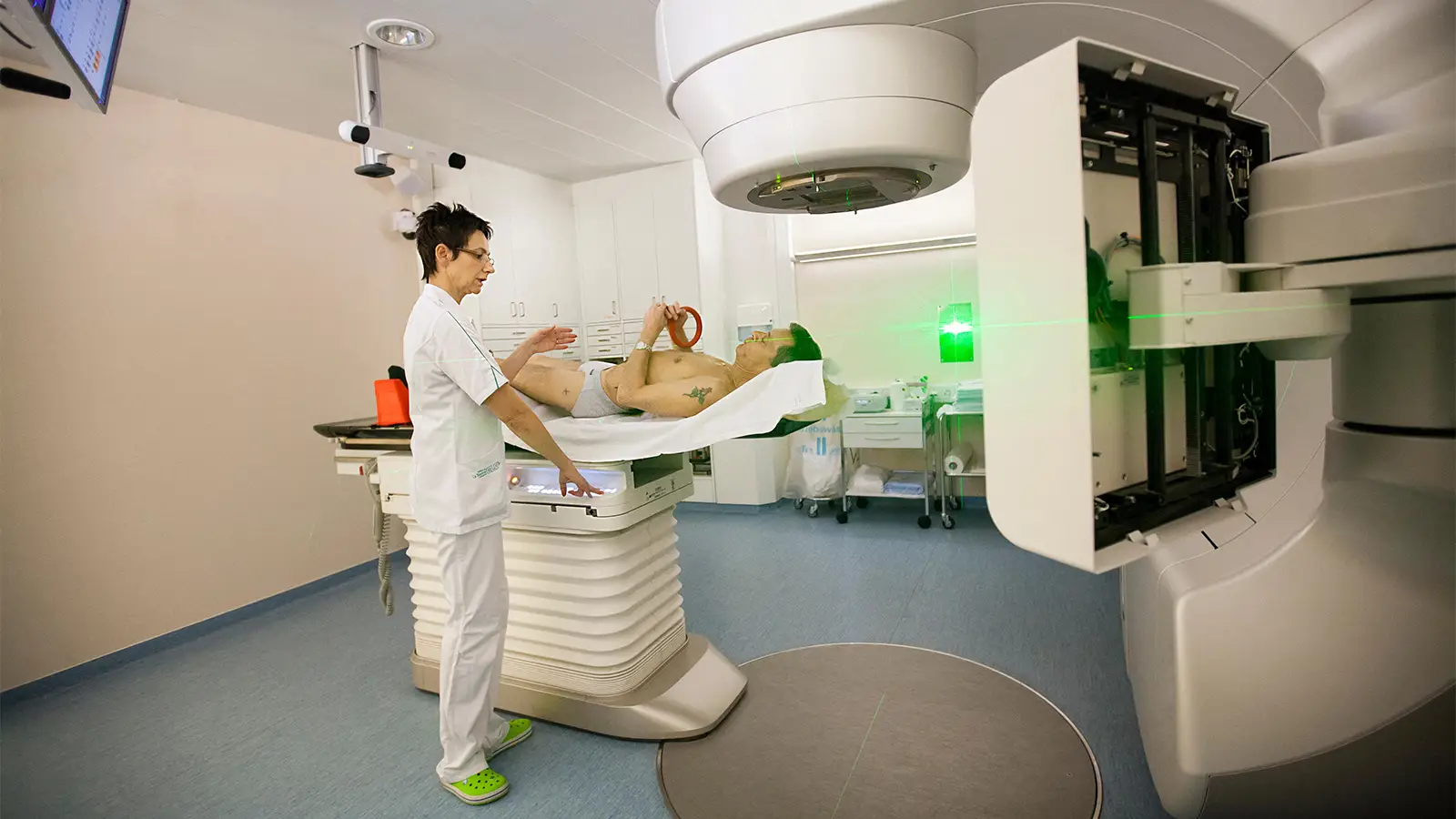
- In the NRG-GU005 randomized trial, stereotactic body radiotherapy (SBRT) for localized prostate cancer failed to improve urinary irritation or disease-free survival rates compared with moderately hypofractionated intensity-modulated radiation therapy (IMRT).
- IMRT led to better 3-year disease-free survival.
- SBRT was associated with fewer severe genitourinary adverse events and some improvements in quality-of-life factors.
Stereotactic body radiotherapy (SBRT) for localized prostate cancer did not improve urinary irritation or disease-free-survival (DFS) compared with hypofractionated intensity-modulated radiotherapy (IMRT), a large randomized trial showed.
After a median follow-up of 3.2 years, the frequency of urinary-irritative symptoms was 35.4% with SBRT and 33.7% with IMRT, although the incidence of several other urinary and bowel symptoms was improved at various time points. The DFS at 3 years favored moderately hypofractionated IMRT, 92.1% versus 88.6%.
The rate of prostate specific antigen (PSA) failure did not differ between the two groups, reported Rodney J. Ellis, MD, of the University of South Florida in Tampa, and colleagues in JAMA.
“This study has immediate impact on patients and physicians considering a shorter course of radiotherapy for localized prostate cancer,” the authors stated. “Furthermore, there are several important insights drawn when this study is placed in the context of prior randomized studies investigating SBRT for prostate cancer. The DFS is numerically worse for SBRT … so it remains possible that improved freedom from adverse quality-of-life effects may come at the price of worse DFS should this difference become statistically significant with further follow-up.”
Beyond the actual results, the study offers some broader lessons for the future of prostate radiation therapy (RT), according to the authors of an accompanying editorial. The trial reinforces the importance of radiation dose in determining biochemical control, so a logical next step for SBRT would be to evaluate ways to escalate dose while maintaining acceptable toxicity, wrote Stanley L. Liauw, MD, of the University of Chicago, and W. Robert Lee, MD, of Duke University Medical Center in Durham, North Carolina.
Second, the “narrow separation” between tumor control and complications suggests the importance of factors beyond radiation dose, they continued. Treatment margins and motion management might play a key role.
“Ultimately, the most important message … may be that optimizing prostate cancer outcomes requires attention to a constellation of treatment parameters rather than a singular focus on fractionation schedule,” Liauw and Lee concluded. “Longer follow-up of this study will be important to better understand the differences observed between SBRT and MH [moderately hypofractionated]-IMRT at this relatively early time point. … As radiation therapy for prostate cancer continues to evolve, the lessons from [this trial] will help guide the next generation of innovation.”
The NRG-GU005 trial had its origin in the recognition that the time demands and toxicity of radiation therapy impact patients, caregivers, and “entire healthcare systems,” Ellis and colleagues noted in their introduction.
To address those issues, investigators at 136 centers in Asia, Canada, Europe, and the United States randomized 698 patients with newly diagnosed intermediate-risk prostate cancer to SBRT (36.25 Gy in five fractions) or IMRT (70 Gy in 28 fractions or 60 Gy in 20 fractions). The primary outcomes were the frequency of a minimally clinically important decline (MCID) in urinary-irritative/obstructive and bowel symptoms at 2 years and DFS at 3 years.
Previously, the PACE-B trial showed that SBRT and conventional RT had similar clinical/biochemical failure rates in men with intermediate-risk localized prostate cancer.
The report from NRG-GU005 showed no significant difference in the urinary-irritative domain of the Expanded Prostate Cancer Index Composite-26 (EPIC) questionnaire (P=0.68) after 2 years. The DFS advantage for IMRT at 3 years met statistical criteria for rejecting the alternative hypothesis favoring SBRT (P<0.001).
Analysis of secondary endpoints showed less urinary incontinence after 1 and 2 years and better sexual function at 1 year in the SBRT arm. Significantly fewer grade 3/4 genitourinary adverse events occurred with SBRT (0.6% vs 2.5%, P=0.04), and a significantly lower incidence of MCIDs in the bowel domain of the EPIC-26 (34.9% vs 43.8%, P=0.03).
“This study provides an important advance in the understanding of the radiotherapeutic treatment of prostate cancer,” the authors stated. “SBRT is more convenient and less expensive than conventionally fractioned radiation. While SBRT requires fewer treatments, it is a more complex technology and requires more staff effort and physician oversight. Recently proposed legislation in the U.S. attempts to provide reimbursement regardless of treatment fractionation, encouraging physicians to choose the treatment they believe is best without potentially conflicting reimbursement incentives.”




Leave a Reply