

Written by: Daniel A. Campeas, DMD
Anterior enamel fractures are one of the most common traumatic dental injuries encountered in general practice. Although Ellis Class I fractures are often asymptomatic, management recommendations vary considerably among clinicians. When overlooked as incidental findings or simply not documented in routine examinations, these fractures represent a missed opportunity for a minimally invasive restorative treatment that will produce aesthetic results.
Why These Cases Matter
Many patients may be unaware that a restorative solution exists for a tooth fracture. Not only that, but a significant percentage of these fractures have been impacting patients’ smiles for years or even decades. When the topic is broached, adult patients frequently disclose that these fractures largely occurred in adolescence. These defects can now be restored with minimal tooth preparation, limited risk and attain remarkable visual and functional improvements.
Reducing Complexity
Tooth color is a complex interaction of absorption, scattering, and light transmission. Unlike traditional composites which rely on pigments for color, universal shade composites such as the OMNICHROMA (Tokuyama Dental America) composite family utilizes 260 nm spherical fillers to generate color through Mie scattering. The fillers preferentially scatter wavelengths within the yellow-red region of the visible spectrum that correspond to natural tooth color.
Clinically, this enables the chameleon coloring effect. The restoration itself does not change color, rather, it integrates with the adjacent tooth structure. As a result, margins become less perceptible to the human eye.
Conventional composites rely on multiple shades and varying degrees of translucency to reproduce natural tooth color. In contrast, universal shade composites, which rely on the Mie scattering principle, negate the need for extensive layering. This facilitates a more natural-appearing restoration that maintains its lifelike properties under both natural and artificial light.
Preparation Design is Vital
Universal shade composites do not negate the need for beveling, however, they often allow for a more conservative tooth preparation. Techniques such as long-feathered bevels and rounded internal line angles optimize the chameleon effect of the universal shade composite. A long-feathered bevel creates a broad transition zone where enamel gradually decreases in thickness while composite gradually increases. Rounded internal line angles decrease localized internal reflections which, when present, can lead to a darker, shadowed, and overall, less predictable restoration. Gradual transitions allow for a gradient change in the amount of light refracted. Since universal shade composites like OMNICHROMA rely on optical integration with surrounding tooth structure, preservation of enamel is particularly important for maximizing the chameleon effect.
When Universal Shade Composites Perform Best
Healthy surrounding enamel and dentin and its coloration are essential for the chameleon effect to take hold. Universal shade composites are well suited for: Ellis I, Ellis II, Class III, Class IV, Class V, diastema closure, and composite repair.
When minimal natural enamel and dentin remain, the optical interaction necessary for predictable shade matching will be compromised. Large Class IV restorations, discolored dentin, tetracycline staining, fluorosis and mottling are less predictable. Appropriate case selection and clinical judgement are essential for predictable results.
Shape and Polish Make the Restoration Invisible
Replicating natural anatomy will create a more seamlessly blended restoration. Including developmental grooves and a focus on surface texture further improves light reflection and contributes to a restoration that blends seamlessly. Particular attention and time should be focused on recreating an anatomically correct emergence profile with a proportional cervical convexity. Flat emergence profiles can foster flat, dull, and lifeless restorations. Sequential polishing systems are essential for recreating the optical properties of enamel.
Clinical Impact
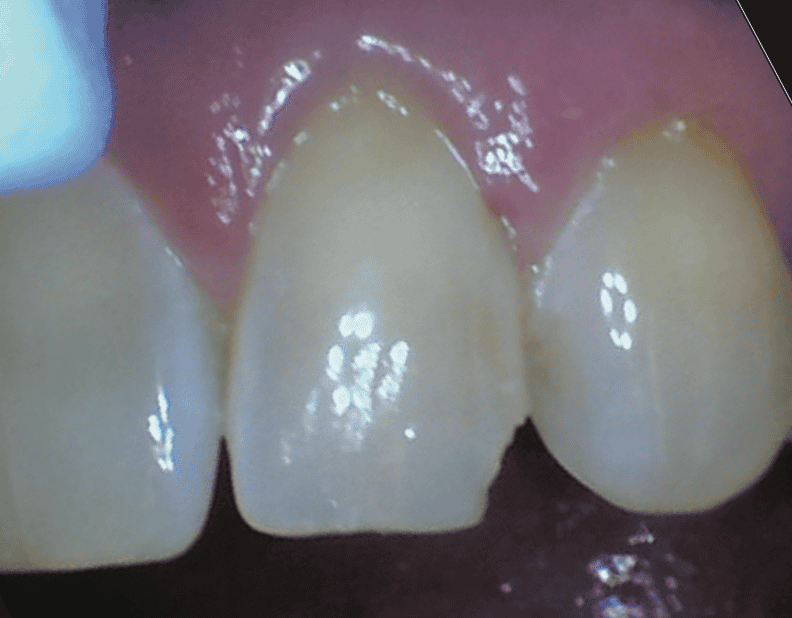
The clinical value of universal shade composites is their predictability enables conservative anterior restorations to be completed during a single appointment. Patients frequently present for routine examinations unaware that enamel fractures can be corrected with minimally invasive adhesive dentistry producing results that are often disproportionate to the size of the restoration. These seemingly small restorations not only preserve tooth structure but also demonstrate the transformative capabilities of modern restorative dentistry. Before and after photos show the results delivered by OMNICHROMA (Figures 1 and 2).
Figure 1. Preoperative.
For more information, visit tokuyama-us.com.
Figure 2. Postoperative.
ABOUT THE AUTHOR
Dr. Campeas is a general dentist practicing in New Jersey with a clinical focus in aesthetic restorative dentistry and minimally invasive treatment techniques. He earned his Doctor of Dental Medicine degree from The Temple University Kornberg School of Dentistry and completed a General Practice Residency at Montefiore Medical Center in New York. Dr. Campeas maintains a strong interest in dental materials and is passionate about continuing education.




Leave a Reply