

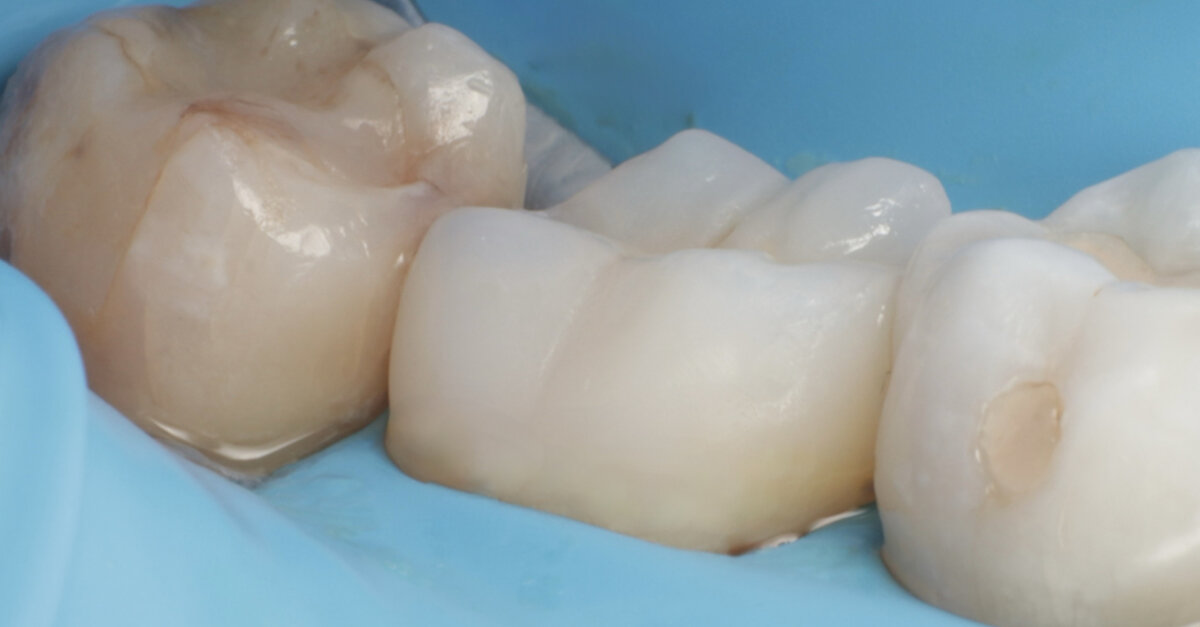
Contemporary restorative dentistry is moving towards increasingly efficient, digital and simplified protocols. The integration of CAD/CAM technologies with universal materials can optimise clinical procedures, reduce treatment complexity and improve the predictability of restorative treatment outcomes. Resin-based hybrid materials, combined with self-adhesive resin cements and universal adhesives, provide excellent mechanical and aesthetic properties, and offer simpler and less technique-sensitive cementation protocols compared with conventional restorative procedures. The following clinical case demonstrates the combined use of CLEARFIL MAJESTY ES Flow Universal, KATANA Cleaner, CLEARFIL Universal Bond Quick 2, KATANA AVENCIA Block 2 and PANAVIA SA Cement Universal (all Kuraray Noritake Dental) in the restoration of an endodontically treated second molar.
Case description
A 48-year-old female patient presented with severe coronal destruction of her mandibular right second molar. The tooth was symptomatic, and endodontic treatment had previously been initiated at another clinic. After clinical and radiographic evaluation, it was decided to complete the root canal treatment and restore the tooth with an adhesively cemented overlay produced using CAD/CAM technology (Figs. 1a & b).
After completion of the endodontic treatment, the remaining tooth structure required stabilisation to provide a reliable foundation for the planned overlay (Figs. 2a & b). Selective enamel etching was performed using K-ETCHANT Syringe, a 35% phosphoric acid gel offering precise application and controlled consistency, followed by the application of CLEARFIL Universal Bond Quick 2. The build-up was completed using CLEARFIL MAJESTY ES Flow Universal Low in the UD shade (Fig. 3). This is a highly filled flowable composite with excellent mechanical properties that is particularly suitable for posterior restorations subjected to functional loading.
Figs. 1a & b: Initial clinical photograph (a) and radiograph of the mandibular right second molar (b), showing extensive destruction of the coronal tooth structure.
Figs. 2a & b: Radiographic (a) and clinical evaluation of the affected molar (b) after completion of endodontic treatment and prior to reconstruction of the lost tooth structure.
Fig. 3: Immediate build-up performed with CLEARFIL MAJESTY ES Flow Universal Low, creating a uniform substrate for subsequent preparation for an overlay.
At the definitive cementation appointment one week later, the internal surface of the restoration was air abraded with aluminium oxide and then cleaned with KATANA Cleaner (Figs. 7a & b). The operative field was isolated with a dental dam (Fig. 8), and the tooth substrate was decontaminated using KATANA Cleaner (Fig. 9a). This universal cleaner contains MDP salt, based on MDP technology, and is designed to effectively remove saliva and blood contamination both intra-orally and extra-orally in just 10 seconds. Cleaning of the surfaces was carried out to optimise adhesion for predictable and durable adhesive cementation.
Selective enamel etching was then repeated using K-ETCHANT Syringe, followed by the application of CLEARFIL Universal Bond Quick 2 (Figs. 9b & c). This universal adhesive is distinguished by its simplified protocol, including a short application time and no waiting time after application, and provides excellent wettability and durable adhesion to both enamel and dentine.
Definitive cementation was carried out using PANAVIA SA Cement Universal Automix in the Universal (A2) shade (Fig. 10). This self-adhesive resin cement contains the functional monomers MDP and LCSi, enabling durable chemical adhesion to zirconia, composites and ceramics without separate primer application. The material offers straightforward handling, and after an initial light-polymerising step of 2–5 seconds, excess cement can be removed in a controlled manner, facilitating the clinical cementation procedure (Figs. 11 & 12).
Finally, the occlusion was adjusted, and the surface of the restoration was polished using TWIST DIA for Composite (EVE Ernst Vetter; Figs. 13a & b; 14). This two-step diamond polishing system is designed to produce a natural-looking and durable gloss on direct and indirect restorations. Clinical and radiographic review was performed one month after cementation (Figs. 15a & b).
Conclusion and implications
The incorporation of universal materials into digital restorative protocols can help simplify indirect adhesive procedures, improve clinical efficiency and reduce technique sensitivity. In this case, the combination of a CAD/CAM restoration with a universal adhesive and cement facilitated a conservative, efficient and highly predictable treatment approach, fully aligned with the demands of contemporary restorative dentistry.




Leave a Reply