

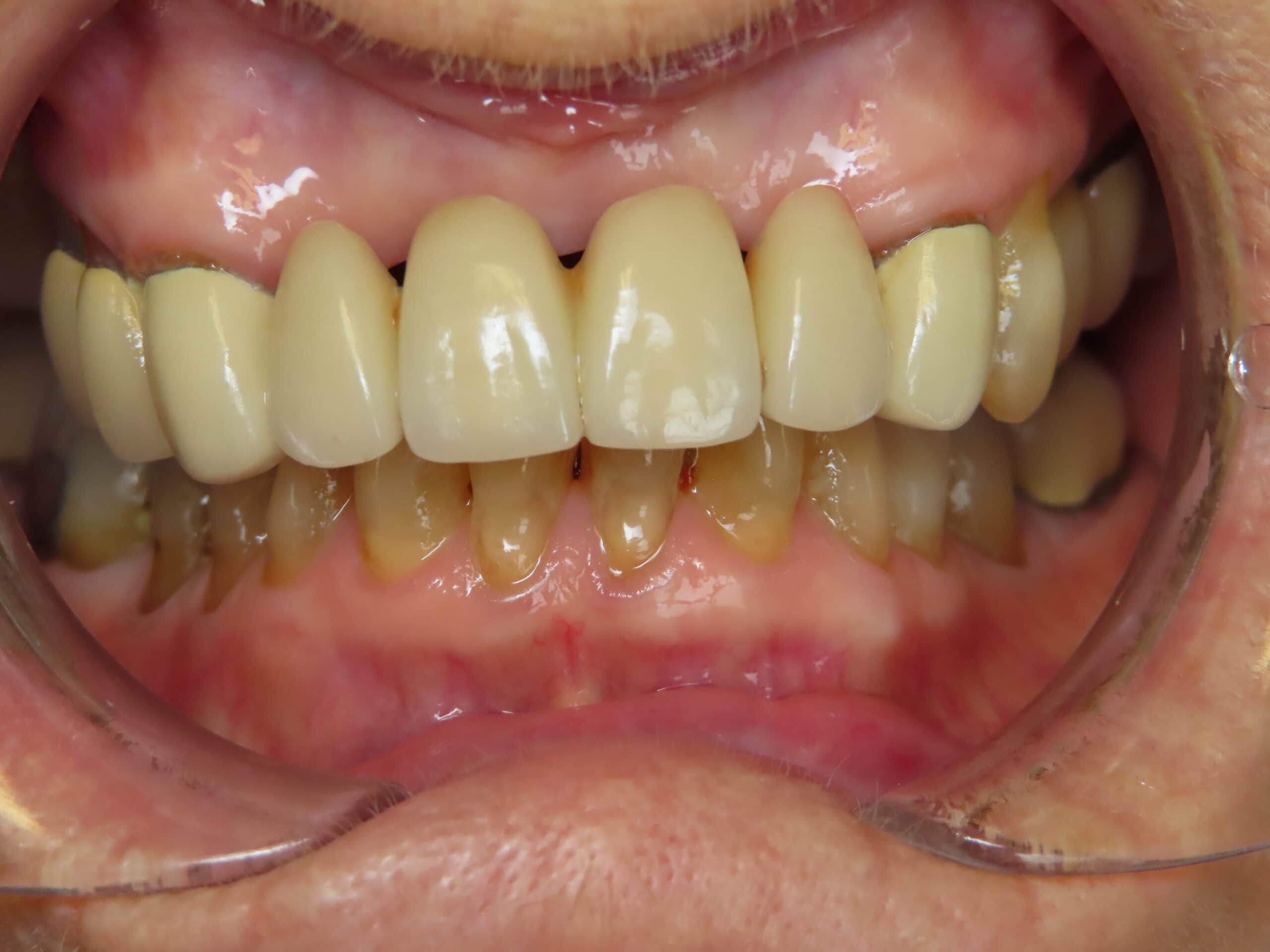
75 Years of Dentistry. A Lifetime of Possibilities.
Written by: Dr. Louis Kaufman, DDS, FAGD, MBA
On November 3, 2026, I had the privilege of seeing a remarkable patient. At 93 years old, she shared a story that reminded me why I became a dentist and what truly defines excellence in our profession.
Her story began more than 80 years ago, when she lost her two front teeth as a young child.
Imagine growing up without your front teeth during some of the most formative years of your life. The embarrassment, the self-consciousness, and the desire to smile without hesitation are experiences most of us can only imagine.
By age 14, she had worked and saved enough money to afford a dental prosthesis. Unfortunately, it never fit quite right. While it replaced her missing teeth, it did not give her the comfort, confidence, or smile she had hoped for.
Determined to find a permanent solution, she sought the opinions of 10 different dentists. Each declined to perform the treatment she wanted because it would require extracting otherwise healthy teeth.
From a clinical perspective, their hesitation was understandable. Preserving healthy tooth structure has always been one of dentistry’s guiding principles.
But this young woman was looking for something more than a replacement for missing teeth. She wanted the ability to smile, speak, and live without constantly thinking about her teeth.
Eventually, she found a dentist willing to listen, understand her wishes, and provide the treatment she had been seeking.
That decision changed her life.
A Smile That Opened Doors
But the story doesn’t end with the restoration of her smile.
The dentist who believed in this young woman saw something beyond the teeth he had restored. He recognized her potential, her determination, and perhaps a future she had not yet imagined for herself.
In an extraordinary act of generosity, he paid for her to attend modeling school.
The young girl who had spent years struggling with her smile was now learning how to present herself confidently in front of a camera.
Think about the transformation.
A child who had lost her front teeth, struggled with an uncomfortable prosthesis, and faced repeated rejection in her search for treatment was now pursuing a profession where her appearance, smile, and confidence were central to her success.
She went on to become a professional model.
The opportunities created through modeling eventually provided her with the financial means to put herself through nursing school.
Dentistry opened the door to modeling. Modeling opened the door to education. And education opened the door to a career devoted to caring for others.
What began as a young woman’s desire to smile ultimately became a pathway to an entirely different future.
The dentist who restored her smile could never have fully anticipated the ripple effect of his decision.
He didn’t just restore missing teeth.
He helped restore confidence, create opportunity, and change the trajectory of a life.
And perhaps there is something even more profound about this story.
One healthcare professional’s generosity helped make it possible for another healthcare professional to enter a career of service.
That is a legacy far greater than any restoration.
Seventy-Five Years Later
On November 3, 2026, this remarkable woman sat in my dental chair at the age of 93.
The dentistry that had changed her life was still serving her 75 years later.
Think about that for a moment.
The materials available to dentists 75 years ago were vastly different from those we have today. There were no digital impressions, CAD/CAM restorations, modern adhesive systems, or contemporary implant techniques.
Yet this dentist, using the knowledge, materials, and techniques available at the time, created a restoration that has endured for three-quarters of a century.
That alone is a testament to the craftsmanship and clinical skills of a previous generation.
But what makes this story extraordinary isn’t simply how long the dentistry lasted.
It is everything that happened because of it.
What Really Defines Successful Dentistry?
We live in an era when dentistry is advancing at an extraordinary pace. Digital impressions, artificial intelligence, 3D printing, guided implant surgery, and advanced restorative materials have transformed how we diagnose and treat our patients.
But this encounter raises an important question:
Are we measuring the success of our dentistry by the technology we use, the beauty of the result, or how well it serves our patients over time?
Perhaps the greatest measure of restorative dentistry is not simply how a restoration looks on the day it is delivered, but how well it functions, how long it lasts, and how profoundly it improves someone’s quality of life.
This patient’s experience also reminds us that dentistry is not always black and white.
Would we recommend extracting healthy teeth for a similar situation today? In most cases, probably not. Modern adhesive techniques, implants, and other conservative treatment options provide alternatives that were unavailable generations ago.
But we must also recognize that successful treatment requires more than applying clinical principles.
It requires understanding the individual sitting in our chair.
What matters to them? What have they experienced? What are they hoping we can accomplish?
The Art of Listening
Ten dentists saw a clinical problem they were unwilling to treat in the way this patient requested.
The next dentist recognized an opportunity to change someone’s life.
That does not mean the first 10 dentists were wrong or that the eventual treatment would necessarily meet today’s standards of care. It means that this patient’s story deserves to be understood in the context of her time, her circumstances, and the options available to her.
Informed patient choice, sound clinical judgment, and a thoughtful understanding of long-term consequences must always guide our decisions.
But there was something else that distinguished this dentist.
He didn’t view his responsibility as ending when the dental treatment was completed.
He saw a young woman with potential and chose to invest in her future.
That investment helped her become a professional model, earn the money necessary to pursue nursing, and build a life she might never have imagined as a young girl struggling with missing teeth.
The True Return on Investment
In dentistry, we often discuss return on investment in terms of technology, materials, efficiency, and practice profitability.
But how do we measure the return on an investment in another human being?
For this dentist, it was the cost of a restoration and an education in modeling.
For his patient, it became a lifetime of confidence, professional opportunities, personal independence, and the ability to pursue a career in nursing.
The restoration lasted 75 years. Its impact lasted a lifetime.
As dentists, we may never know how far the effects of our work will reach.
A smile restored today may influence a career choice, a relationship, or an opportunity decades into the future.
And sometimes the greatest contribution we make to our patients’ lives has very little to do with the dentistry itself.
It has everything to do with seeing the person behind the smile.
A Legacy That Outlives the Dentist
As a dentist who has practiced for more than 30 years, I often think about the legacy we leave behind.
Our patients may not remember the brand of cement we used, the laboratory that fabricated their restorations, or the techniques we employed.
But they remember how we made them feel.
They remember the confidence to smile at a wedding, the ability to laugh without covering their mouth, and the freedom to enjoy everyday life.
And sometimes, if we are fortunate, the dentistry itself becomes part of their story for generations.
This 93-year-old patient reminded me that the finest work we perform may continue serving someone long after we have put down our instruments.
But more importantly, the influence we have on another human being may extend far beyond anything we can measure clinically.
The Ultimate Test of Time
As we embrace new technologies and innovations, we should never lose sight of the fundamental purpose of our profession.
We are not simply restoring teeth.
We are restoring function, confidence, dignity, and quality of life.
And perhaps the most meaningful question we can ask ourselves is not just, “How good does my dentistry look today?”
It is: “Will the dentistry I provide today continue to improve someone’s life decades from now?”
On November 3, 2026, a 93-year-old woman reminded me that great dentistry is not measured only in millimeters, margins, materials, or megapixels.
It can also be measured in opportunities created, careers inspired, and lives transformed.
Seventy-five years ago, one dentist restored a young woman’s smile and then helped her pursue a future.
He could not have known how far that act of generosity would reach.
But I had the extraordinary privilege of hearing the story 75 years later.
The dentistry stood the test of time.
More importantly, so did the kindness behind it.




Leave a Reply