


Bolstering worker health screenings, training, and the use of personal protective equipment (PPE) can help prevent chronic diseases in workers, according to safety experts supported in part by NIEHS.
How to protect workers from exposure to environmental contaminants — such as dust, fumes, gases, and other substances that can lead to the development of chronic disease — was top of mind for NIEHS Worker Training Program (WTP) award recipients during a recent workshop. Chronic diseases develop and persist over time; common examples include asthma, chronic obstructive pulmonary disease (COPD), autoimmune diseases, and cancer.
“The Worker Training Program is committed to preventing chronic disease, and improving the overall well-being of the U.S. workforce,” said WTP Director Sharon Beard who, together with NIEHS leaders and staff, hosted the recent workshop.
Since its inception in 1987, the WTP has trained more than 5 million U.S. workers and continues to share training and resources, so workers can protect themselves, their colleagues, and communities from harmful exposures.
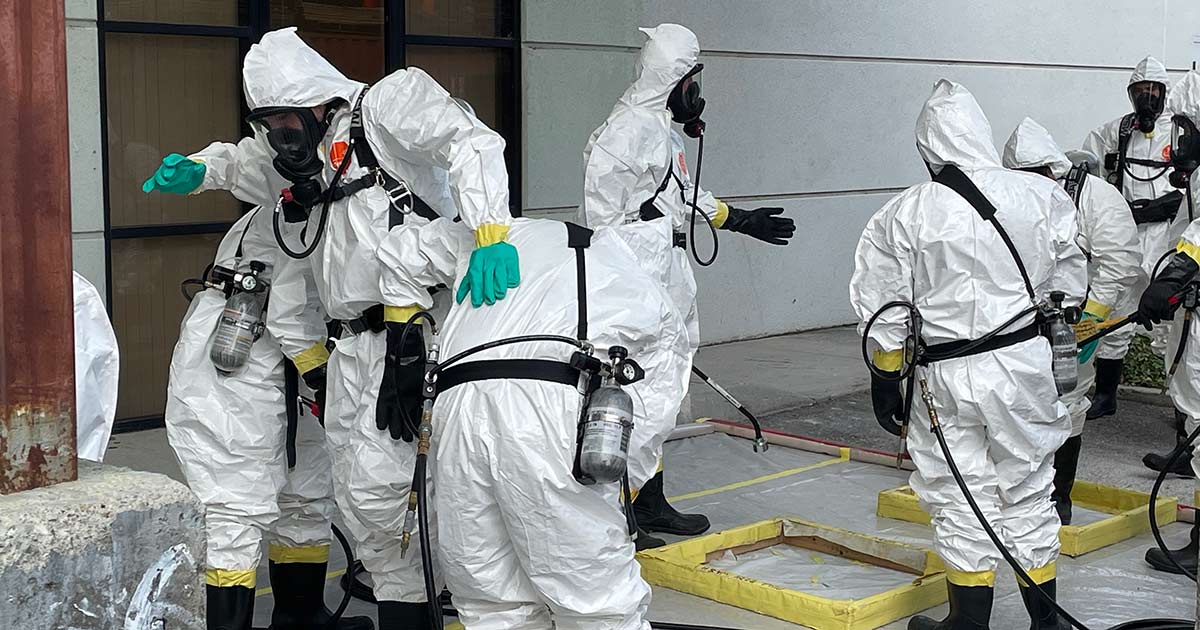
WTP trainees learn how to decontaminate full-body PPE. (Photo courtesy of The Center for Construction Research and Training)
Screening for lung disease in construction workers
Construction workers can be exposed to various toxic materials on the job, with asbestos (1MB), beryllium, and cadmium being some of the materials of greatest concern, explained Knut Ringen, Dr.P.H., senior scientific advisor at The Center for Construction Research and Training (CPWR). These exposures contribute to a higher risk for lung cancer, COPD, colorectal disease, and cancer.
The CPWR Building Trades National Medical Screening Program (BTMed), founded by Ringen in 1996, has provided free medical screenings for approximately 30,000 current and former construction workers employed at U.S. Department of Energy (DOE) nuclear facilities. Screenings include a thorough work history interview to better understand potential exposures, and a medical exam.
Ringen estimated that the program has prevented 3,000 premature deaths from severe disease and added one-and-a-half years of life for each exam participant. Exam participants also have 27% lower mortality than the general population of construction workers, and 53% lower mortality from colorectal cancer.
Another program, the Worker Health Protection Program (WHPP), which is funded by WTP‘s long-standing partner, the DOE, has screened more than 35,000 DOE workers for chronic lung diseases, such as asbestosis, silicosis, and COPD, and 14,000 workers for lung cancer since its inception in 1998. WHPP uses a trailer-based lung scanning unit at the Atomic Trades and Labor Council union hall in Oak Ridge, Tennessee, to increase participation and encourage follow-up scans. WHPP has achieved a 90% retention rate at this and other sites. From 2000-2024, WHPP detected 230 lung cancers, and approximately 75% of those were early stage, said Steve Markowitz, M.D., Dr.P.H., co-founder and co-director of the WHPP.
“We think this partnership approach is really key,” said Markowitz. “The scans help catch lung disease at an early stage, when surgery is more likely to be successful.”
The screening that WHPP offers for other lung diseases is important too, says Markowitz, because it can help current workers understand exposures to dust, vapors, gases, and fumes that may lead to chronic lung diseases. WHPP helps workers identify the occupational connection to their disease, prevent future exposures, and in some cases, provide medical documentation needed for workers’ compensation.
The Early Lung Cancer Detection Unit in Oak Ridge, Tennessee, helps patients catch signs of lung cancer before symptoms even start. (Photo courtesy of WHPP)
Promoting regular checkups for miners
After a period of decline in the 1990s, cases of black lung disease in coal workers have been trending upward since 2000, especially among younger miners, according to Marcus Cervantes, M.D., an occupational medicine physician and assistant professor at West Virginia University. Cervantes partly attributes the uptick to silica dust exposure, which can cause symptoms and lung disease similar to coal dust exposure.
“The reason we’re seeing a lot more silica is that there’s less coal to mine, so companies are chasing smaller seams of coal surrounded by sandstone,” said Cervantes.
He added that a lack of appropriate PPE also likely plays a role.
Cervantes urged WTP award recipients, trainers, and workshop attendees to encourage workers to wear the appropriate PPE and to visit an occupational medicine physician regularly, with the understanding that their job is not in jeopardy if they do so.
“Please discuss your concerns with occupational physicians — we can give you insight into whether an exposure event or hazard is real and needs more testing, or isn’t an issue,” he said.
(Lindsay Key is a senior communications specialist at MDB, Inc., a contractor for the NIEHS Division of Extramural Research and Training.)
