

by Gretel
Kauffman
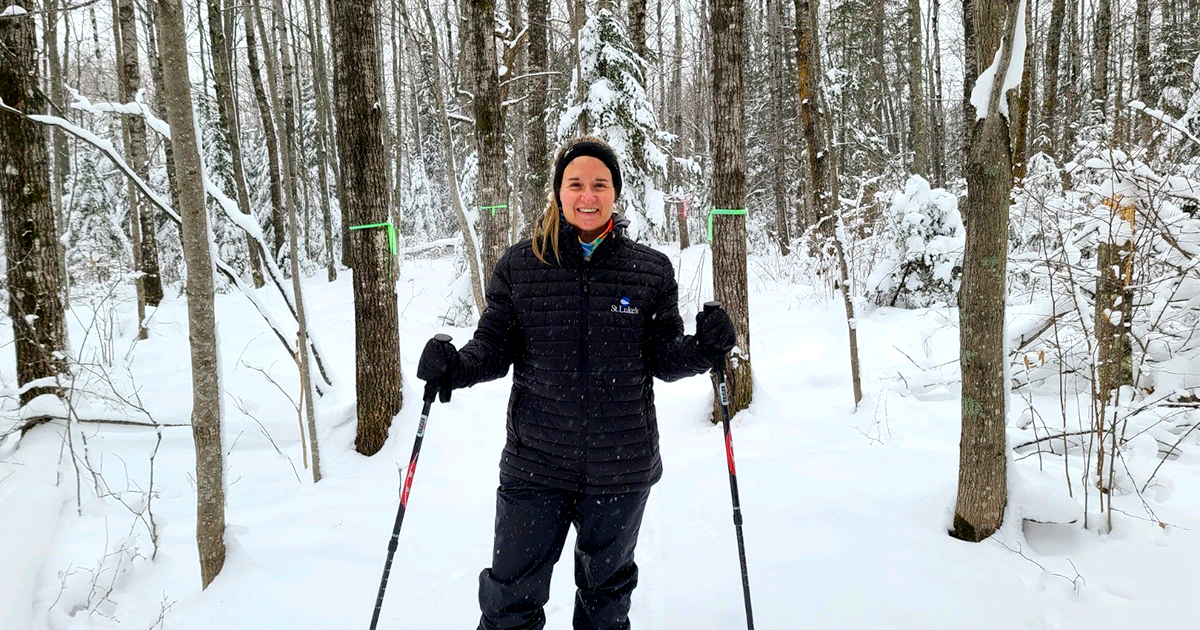
Alyssa Meller snowshoes on her property. Meller was
diagnosed with multiple sclerosis while living in a
rural part of Douglas County, Wisconsin.
Alyssa Meller considers herself lucky.
When Meller first began to experience numbness in her
legs — the first indicator that would
eventually lead to a multiple sclerosis (MS) diagnosis
— the pieces fell into place about as smoothly
as they could. Her primary care provider was attentive
and proactive, ordering an MRI and referring Meller, who
lived in a rural part of Douglas County, Wisconsin, to a
neurologist in nearby Duluth. Her parents, both
healthcare providers themselves, helped her to get seen
by a specialist quickly. And within four months of her
primary care visit, Meller had a diagnosis.
Seventeen years later, Meller’s condition has remained
stable, with no signs of progression —
something she attributes in large part to her early
diagnosis and treatment.
Meller’s story is unusual, particularly for a patient
living in a rural area. In the best of circumstances,
getting an MS diagnosis is often a long and complex
process. But for people in rural communities, the
challenges are compounded: A shortage of specialists in
rural areas often means travel and long wait times to see
a neurologist, and identifying the signs early
— the key to a timely diagnosis — can
be difficult for primary care providers without
specialized training.
More than 80% of rural Americans live in an MS specialist
“desert,” according to research funded by the National Multiple
Sclerosis Society (NMSS). Organizations including the
NMSS hope to plug these gaps in care with enhanced
resources and training for rural providers.
…everyone should have the same type of access to these
services that I’ve had.
“I was very, very fortunate to get access to that care
within a relatively short amount of time,” said Meller,
who serves as chief operating officer of the National Rural Health
Resource Center (the Center), a nonprofit providing
technical assistance to rural health organizations. “And
I think everyone should have the same type of access to
these services that I’ve had.”
‘Overlooked’ Symptoms
Only around 13% of people in rural counties have full
access to neurological care, according to NMSS research.
“There’s a shortage of neurologists nationally, and that
shortage is not uniformly applied,” said Carolyn Bevan,
associate director of telehealth for the Multiple Sclerosis Centers of
Excellence (MSCoE), a program of the U.S. Department
of Veterans Affairs (VA). “If you live in a rural area,
you’re less likely to have access to any neurology. And
subspecialty neurologists, like MS neurologists, become
very difficult to find.”
It’s “not uncommon” to hear of rural MS patients having
to travel three to six hours, or crossing state lines, to
receive specialty care, said Alana Skye Campbell, who led
a rural pilot initiative as senior director of healthcare
access at the NMSS.
In a rural area, there’s often not a good bus or train
line. You can’t just Uber seven hours. It’s a very
complicated, difficult process of getting to see those MS
specialists.
“Think about that travel time compounded by how MS
functions as a disease and the symptoms that accompany
it: things like fatigue, brain fog, mobility challenges,”
Campbell said. “In a rural area, there’s often not a good
bus or train line. You can’t just Uber seven hours. It’s
a very complicated, difficult process of getting to see
those MS specialists.”
Travel difficulties can lead to delays in diagnosis and
treatment, noted Vicki Kowal, senior manager of
healthcare access for the NMSS — delays that
can be “hugely problematic” when dealing with a
progressive disease. Disease-modifying therapies (DMTs)
— medications taken orally, via infusions, or
by injections — can significantly slow or, in
the case of Meller, stop the worsening of MS symptoms
over time. But the progression of the disease can’t be
undone — meaning that the sooner a patient
begins treatment with DMTs, the better.
Also complicating the diagnosis process: the fact that MS
is often not immediately identifiable, especially for
non-specialist providers.
“Multiple sclerosis symptoms are often very similar to
other diseases or conditions,” Meller said. “And since MS
may not be as known or common as these other conditions,
they may get overlooked.”
National MS Society staff members at the 2024 Southeast
Community Health Worker Summit. From left to right:
Casey Tinsley, Moriah Nell, and Alana Skye Campbell.
Early-stage MS symptoms can include numbness, fatigue,
vision problems, and issues with balance or dizziness
— relatively common ailments. Symptoms such as
fatigue “can easily be attributed to something else” from
the perspective of a primary care provider, Kowal said:
“Maybe this person is working long hours, or maybe
they’re a new parent and so they must be tired from
that.”
Complicating diagnosis further is the fact that the vast
majority of people with MS are first diagnosed with
relapsing-remitting MS (RRMS), a version of the disease
where symptoms can come and go over time. The resolution
of symptoms can lead some people to delay seeing a
healthcare provider, making a diagnosis take months or
even years. People often think there is no need to keep
that appointment with a neurologist because their
symptoms went away, according to the NMSS, and it’s not
until they have another relapse that they seek care. By
then, permanent damage from MS may have occurred.
Even for neurologists, the complexity of diagnosing MS
has in some ways increased over time, Bevan noted. Since
an update to the diagnostic criteria in 2024, Bevan has
seen general neurologists relying more on their
MS-subspecialized colleagues to help them navigate those
criteria and confirm diagnoses.
Additionally, she said, “I think some of our
disease-modifying therapies certainly have better
efficacy, but perhaps more risk associated with them as
well, and monitoring requirements that have made general
neurologists maybe less comfortable managing them and
wanting the backup of a subspecialist to help them make
sure they’re making the right choice.”
Expanding Virtual Care
For VA-based providers, that’s where Bevan — a
neurologist specializing in MS — comes in to
help. The VA’s
National TeleNeurology Program (NTNP) connects
neurologists with rural VA sites around the country that
have few, or no, neurologists of their own onsite.
Through telehealth consultations, the neurologists help
local VA providers diagnose and manage neurological
conditions. In cases where an MS subspecialist is needed,
Bevan provides virtual consultations to local providers
and general neurologists.
While she does field questions about symptom management
and how to personalize disease-modifying therapies to
meet a particular patient’s needs, Bevan said she more
often receives questions from providers wanting to
confirm a diagnosis: “‘Do I have the diagnosis right? And
am I treating them correctly?’ The big challenge is when
there’s nuance, where the symptoms are a little less
clear or the MRIs are a little bit unusual.”
Oftentimes, confirming a diagnosis requires some
detective work.
“Because there’s a lack of access for people in rural
settings, they end up going to a lot of different
places,” Bevan said: neurologists outside of the VA
system, for instance, or multiple VA locations. “There’s
a lot of fragmentation of care because they can only get
certain services in certain places.
“Part of my role is to do the digging and put together a
comprehensive story of what has happened to this person:
what they have, what they don’t have, what they’ve been
treated with already, why they stopped it,” she
continued. “Once you can create that holistic picture,
then it becomes a lot clearer what their diagnosis is.”
Through her work at the Center, Meller has seen the
importance of rural providers having access to virtual
consultations with neurologists and MS specialists.
“That’s just paramount for our rural providers,” Meller
said.
The Center’s technical assistance programs help rural
hospitals and clinics analyze the services they currently
offer and identify opportunities to grow and expand. In
some cases, those organizations have identified neurology
care as an area for expansion. Currently, the Center is
working with its sixth rural healthcare organization to
expand access to neurology services.
“Our organization is dedicated to helping our rural
providers keep care local,” Meller said. “I think if we
can continue to provide that education on symptoms and
how they reoccur and access to neurology telehealth
consultations, it will increase early awareness and start
that diagnosis process.”
‘Boots on the Ground’
Vicki Kowal and Ashtyn Mullinax
The NMSS has also taken advantage of technology to reach
rural providers. A neurology ECHO (Extension for
Community Healthcare Outcomes) program created in
partnership with the
University of Mississippi’s Center for Telehealth and
Emerging Technologies wraps up its first trial year
this month.
“Primary care providers have so many responsibilities and
play so many roles,” Campbell said. “So we had to figure
out how to provide this information and training and
education in a way that allowed them to learn about MS
while recognizing that they’re very busy.”
But many of the NMSS’s rural education efforts have taken
place on the ground, with a focus on a different type of
provider: community health workers (CHWs). A rural
initiative pilot program in Arkansas, Mississippi, and
Alabama worked with local communities to develop training
opportunities for CHWs. The aim, Campbell and Kowal said,
is that CHWs can help to catch early signs of MS and
assist patients in navigating and managing their care
once diagnosed.
We really wanted to reach community health workers
because they’re frontline.
“We really wanted to reach community health workers
because they’re frontline,” Kowal said. “They may be the
very first people to hear about these symptoms, and they
will be the very first people to hear about any access
issues to resources like transportation, the ability to
pay for an appointment, or whether that person has health
insurance.”
Ashtyn Mullinax, who serves as CHW lead for the Arkansas Rural Health
Partnership, has worked as a community health worker
in rural Arkansas for the past six years. A year or two
ago, Mullinax said, “I probably couldn’t tell you a lot
about MS. Now, I can.”
After participating in and leading numerous trainings
with CHWs across the state — often through
collaborative learning sessions that bring CHWs together
for education, peer discussion, and shared experiences
— Mullinax has become well-versed in MS
symptoms and common challenges for rural Arkansan
patients. For patients who live an hour or more from an
MS specialist, transportation is often a “huge burden,”
she said. CHWs can also help MS patients navigate their
prescriptions and ensure their specialist is in their
insurance network, she said.
“There are boots-on-the-ground community health workers
getting out there and training [other CHWs],” Mullinax
said. “What are the symptoms? Where are the resources?
How do we get that MRI scheduled? How do we get funds for
someone who doesn’t have them? How can they pay for
medication that is astronomical? It’s filling in all the
gaps to make this work.”
The pilot program looks slightly different in each state
based on community needs, Campbell and Kowal said.
“It was about first starting conversations, listening,
learning, and understanding from the clinical
stakeholders in those communities where we can work
together,” Campbell said.
“We know MS, and the community knows everything else,”
Kowal added.
Also important to the NMSS: making sure the CHW training
programs could continue independently into the future.
“We really tried to make sure our efforts became
institutionalized,” Campbell said. “With or without the
Society, they have those resources at the ready.”




Leave a Reply