
Transcript
Andrew Nelson: Welcome to Exploring
Rural Health, a podcast from the Rural Health Information
Hub. My name is Andrew Nelson. In this podcast, we’ll be
talking with a variety of experts about providing rural
healthcare, problems they’ve encountered, and ways in
which those problems can be solved.
Today we’re going to be talking about an initiative
providing buprenorphine to individuals experiencing
opioid withdrawal symptoms at the Lincoln County
Sheriff’s Office Jail in Troy, Missouri. It began
specifically as an overdose prevention effort and has
developed into a medication-assisted treatment [MAT]
program helping folks on the path to recovery.
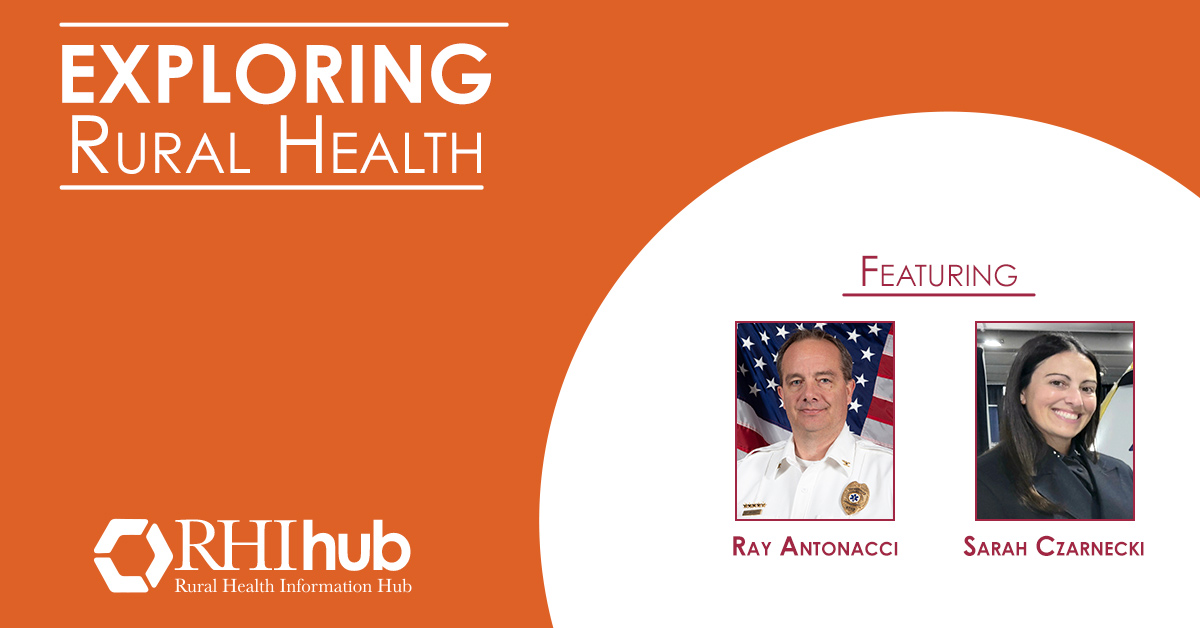
Joining me is Lincoln County Ambulance District Chief Ray
Antonacci and Battalion Chief Sarah Czarnecki. Thank you
both for joining us today.
Ray Antonacci: Thanks for having us.
Sarah Czarnecki: Yeah, thank you for
having us.
Andrew Nelson: To provide a little
context here, can you walk us through how the idea of
bringing buprenorphine treatment into the Lincoln County
Jail first emerged?
Ray Antonacci: Yeah, I can kick that
off. So, we were grant-funded by the HRSA RCORP grant to
give buprenorphine in the field, and we did Narcan
wake-ups. And we just were not seeing the calls of Narcan
wake-ups that we had seen in years past. So, in a
one-year grant, we really knew that we needed to gather
up more data than we were getting. One day I was having a
conversation with the sheriff and it was just a casual
conversation, and he was mentioning that he wanted to
have zero deaths from overdose in his jail. And he
started telling me about the problems with fentanyl being
smuggled into the jail. So, I proposed us coming in, and
using buprenorphine to help inmates that were going
through withdrawal.
Sarah Czarnecki: We spent years
responding to overdose after overdose after overdose,
administering Narcan every single time. And that was our
original plan. But we had to pivot, and we found the
population we were looking to work with in the jail
setting.
Buprenorphine has a higher affinity to that opioid
receptor than fentanyl or any other opioids. So, I know
that if I’ve administered someone that medication in the
jail, at least for the next 6, 8, 12 hours, even if they
do try to use, it’s not going to work. If they try to use
some random opioid from someone, it’s a good safety net.
It doesn’t work as a blocker, but it works like ice in a
cup as opposed to water in a cup. It fills that cup up
just like water would, but it leaves holes. So, it has
that ceiling, that partial agonist, and it has that
higher affinity. So, what a great medication to be able
to utilize in that overdose prevention space.
Andrew Nelson: You said that the sheriff
reached out to you, correct?
Ray Antonacci: It was more like a casual
conversation, really. We’re friendly. We see each other
at Rotary meetings and community meetings like that. So,
this grew from a friendly conversation of, “What’s going
on in your world?” And we knew that there was a recent
death in the jail from an overdose. And when that subject
came up, he had mentioned that he wants to have zero
deaths in his jail; that’s his goal. And I just quickly
jumped on that opportunity to tell him about our
buprenorphine program. And he accepted it right away.
Now, when I say that he accepted it, that doesn’t mean
that everybody accepted it. So, between the two
administrators, we now had a program. Of course, it
wasn’t in writing, but we had an idea for a program, and
then, it took time for us to sit down and write out
protocols, and get a written document in place, a
partnership, spell out everything that each one of us is
going to do. That took a little bit of time.
And it’s kind of funny — finally, one day, as
we were going back and forth, trying to make it perfect,
I was tired of waiting. I just handed my cell phone
number over to the community behavioral health liaison.
And I said, “Tell the COs [corrections officers] to call
me if they have a person who’s going through withdrawal
from opioids.” A few days passed, and then one day I got
a phone call, and it was my time to shine, right? I got
the phone call, I got my box of meds, I go in there, and
this is the first time I’ve administered this medicine.
So, I go in and utilize the medication, and I was
astounded at how quickly the patient started to turn
around. She went from being cold, sweaty, climbing all
over the bench, just couldn’t sit still. She had a very
high COWS score, which is an opioid withdrawal score. She
just started to calm down, and I came back to the
ambulance district and told Sarah and anybody else that
would listen to my story, how well this worked. I was
ready to treat the world. It was very cool.
We have not had a death in two and a half years, and
we’ve had only a couple of overdoses, which were not
opioid-related. So, we really encouraged the inmates to
use our medication rather than using smuggled-in
medication.
When I first started the program, I administered the
medication every 12 hours. And so, I would go in, in the
morning and in the evening. And as you can imagine, there
are a lot of moving parts to moving inmates around the
jail and getting them to me or to Sarah to have
medication administered to them, and our own schedule of
running an ambulance district. It became very tedious; a
lot of documentation, a lot of time. So in the end, as
the chief of an ambulance district, I ended up having to
hand it over to Sarah. I told Sarah I was drowning. I
just had too much work, and I wasn’t keeping up with
everything. And Sarah, to her credit, she stepped right
in. And about a year and a half ago or so, she took over.
Andrew Nelson: Sarah, do you want to
tell me a little bit about what it was like to take over
from Ray?
Sarah Czarnecki: Absolutely. It was a
job. I don’t know how he stayed afloat as long as he did.
[With] the amount of patients that we have at the jail,
time is about three hours every time we would go and
dose. And if we were there in the morning and we would
dose 10 or 15 people, and then we were in there in the
evening and dosing 10 or 15 people, and then you have to
do all the documentation that comes with that… it was
about six hours a day that we had to contribute. We did
some revamping of the program as we figured out, “This is
a lot. We need to make this more sustainable.” And we now
go once a day. I had to go find the evidence to make sure
that it was best practice to be administering this
medication once a day, and that it was still okay to do
so. So that was what our program has ultimately
transformed into. I go once a day to administer
medication every morning, which definitely cuts down on
the amount of time that we are there.
Andrew Nelson: You said you’ve been
doing this for about two and a half years. Right now,
you’re midway through an RCORP Overdose Response grant.
How were you funded previously?
Sarah Czarnecki: Well, this is our
second grant funding with the same grant. That’s what has
allowed us to continue.
Ray Antonacci: And what’s interesting
about that is that it took about half of the first grant
period for us to just figure out what we were doing. Like
I explained before, it was a lot of document-writing and
a lot of back-and-forth until finally, we just started
working. So, we only had less than half a year of
patients the first time. But it worked so well, that in
between the end of our first grant period with the RCORP
grant and the beginning of the next RCORP grant, there
was about six months. The Sheriff’s Department paid for
the buprenorphine. We supplied the manpower, and the
sheriff’s department came up with some money to continue
the program. I just explained to them that we were out of
grant funds, and they found the money somewhere in their
budget and were able to continue it. They believed in it
that much.
Andrew Nelson: You understood the value
of buprenorphine, especially when it comes to managing
those withdrawals of incarcerated individuals. Can you
tell me about some of the obstacles that you encountered
getting going, and how you were able to move past those?
Ray Antonacci: The difficulty that I
encountered right at the beginning of the program was
stigma. Trying to get the corrections officers to
understand the medication and understand that we were not
trading one drug for another, and that we were trading
one illicit drug for a medication, a treatment drug, and
get them to understand that this was not a form of
punishment, and this was not a form of privilege. This
was just medicine. So that was one of the biggest things
that I had to get over. And I think that as I handed it
off to Sarah, she still met that same resistance from not
only people in the jail, but our own paramedics.
Sarah Czarnecki: Absolutely. It’s really
difficult, and I had to shift my lens as well, when it
comes to substance use. Many people continue to see
substance use as a moral failing, and not a diagnosable
disorder. And when we are able to see it as a diagnosable
disorder, just like hypertension or just like COPD, we
can then understand, if we have diagnostic criteria, we
could also have interventions to treat that, including
medication. And that’s still something I stress and
educate on within the jail, as well as with my own
coworkers.
Andrew Nelson: Yeah. I think a lot of
people, when they’re being introduced to a concept like
that, feel like, “Well, you’re enabling these people,”
but reframing it as just providing medication for a
condition that they have, that can make a lot more sense
to people.
Sarah Czarnecki: Absolutely. I like to
compare it to high blood pressure. So many patients that
paramedics come in contact with have high blood pressure.
And a lot of times we ask people, “Do you have high blood
pressure?” And they say “No.” And then we find on their
medication list, “You take a medicine, your blood
pressure is not high because you take the medicine.” And
the same concept can be utilized with substance use
disorder. Your substance use disorder is not negatively
affecting your life, because you’re using medication to
treat the disorder. People can come off of blood pressure
medication, no problem. Right? There’s other things that
have to happen, though. They have to have lifestyle
changes, exercise, eat healthy, lower your cholesterol,
and then maybe we can talk about no more high blood
pressure medication. The same concept can be utilized
with buprenorphine and substance use or opioid use
disorder. It’s a hard, hard lens, and it’s a hard sell
for many people. But when I was able to shift my lens to
that, it helped me look at it in a whole different way.
Andrew Nelson: Initially, you were just
responding to somebody from the jail calling you to treat
somebody who was experiencing withdrawal. Who qualifies
for this program, and how do you determine which
individuals are appropriate candidates for
medication-assisted treatment versus other treatment
pathways?
Sarah Czarnecki: We utilize a protocol
in the state of Missouri. There are standing orders;
protocols that are predetermined. Every entity has their
own medical director. So, within that protocol, we find
someone that could be a candidate who’s experiencing
opioid withdrawal. And we go through what’s called a COWS
scale, a Clinical Opioid Withdrawal Scale. We use the
number 7. So anybody who has a COWS score of seven or
higher qualifies for buprenorphine. Most everyone
self-discloses, “Yes, I use opioids or fentanyl.” The
higher the number, the worse the withdrawal symptoms are.
We evaluate the patient, make sure that there’s no
contraindications, because there are a few
contraindications. And if they are willing to take
medication, we administer medication.
Andrew Nelson: Can you tell me about how
the paramedicine model differs from traditional emergency
responses to the same issue, and how this approach can be
particularly well-suited for addressing opioid withdrawal
in the incarcerated population?
Ray Antonacci: I’m going to give kind of
a short answer to that, and then you can expand on it
with community paramedicine. How this differs is really
night and day. The old response is, “Let’s wait for them
to almost die, or die.” Then we respond to them. We
either A), wake them up, or B), pronounce them dead. And
then we either take them to the hospital or wait for the
funeral home to come get them, or the coroner to come get
them. What we’re doing is, we’re catching them when they
are in withdrawal. But we can keep them on our
medication, keep them stable, and keep them from
utilizing fentanyl or any other opioid that’s been
smuggled into the jail.
Buprenorphine has a therapeutic ceiling, and they won’t
die from an overdose. Even if it gets diverted to someone
else, it’s not going to hurt them. So, where our medicine
works is that it cuts the cravings and it cuts down on
their usage or desire or craving for that illicit drug.
So, we don’t have to respond to the jail 911 at 2:00 in
the morning for an overdose. And I get kind of
sentimental about this sometimes, and I’m like, “You know
what? No matter what they’ve done in their life, they’re
in jail obviously for a reason… they did something, but
they’re somebody’s kid. They’re somebody’s father.
There’s somebody’s husband, wife, girlfriend, boyfriend,
and we owe them the best medicine that we can give them
in our community.” So that’s what we’re doing. We’re
working towards the prevention of death. And as long as
we can prevent death, they can go to recovery. They don’t
get recovery after death.
Andrew Nelson: Do you have a sense of
how individuals have stayed connected to recovery
services after they’ve been released? Or is that beyond
the scope of your involvement?
Ray Antonacci: We do have some
wraparound services, and some of these folks have been
difficult to keep track of. So that’s one of our data
points that we’ve been working on.
Sarah Czarnecki: We have in our protocol
that we don’t want to leave people high and dry without
access to the medication. So, we have a referral that we
send to virtual care. And once they engage with that
virtual care, we do lose track of a lot of people.
However, sometimes within those first 24 to 48 hours, we
have connection with those people that they get out;
we’re able to connect them with what are called “bridge
medications” to get them to that virtual provider. So
those first few days, we may have connection with them
after they get out. After that, connecting with them is a
little more difficult.
Andrew Nelson: What does the internet
connectivity situation look like around Troy? Is that
something that’s available so it’s easy for folks to
access the virtual care?
Ray Antonacci: We have some larger towns
that have pretty good internet. But a lot of the folks
that leave the jail, they end up living pretty far out of
town or in a trailer out on somebody’s farm. And we have
difficulties with that. We were just on a meeting earlier
today, and one of Sarah’s barriers is that people don’t
have phones, and she’s bought multiple phones with phone
cards for people to use. So, that’s a way that we’re
trying to get over that barrier. But again, that takes
money.
Andrew Nelson: You already talked about
stigma. Would you say that there were other challenges
that you’ve you had to overcome that you haven’t already
talked about?
Ray Antonacci: Provider shortages have
been an issue. We’re currently putting many of our
paramedics through community paramedic school to get the
additional education to go out into the community and do
more prevention work on chronic disease management and
behavioral health and, in our case, with this grant, the
substance use programs. But there is a shortage of
paramedics in Missouri. So, the more people I take off an
ambulance and put on the street to do prevention work, I
have to replace those people with people to run the 911
calls. And that becomes difficult. So, I’ve got a
balancing act as a chief to keep trucks rolling out the
door for our main mission of running 911 calls and
responding to people’s emergency and starting this new
service line.
Sarah Czarnecki: I think the stigma has
been the biggest one, not only for myself, but for
everyone that we come in contact with. I very rarely have
to defend what we do with buprenorphine. And it’s a
difficult population. It’s a difficult, and new, concept.
Andrew Nelson: We’ve mostly been talking
about the interactions that you’ve had with the sheriff’s
department and then of course patients that are
incarcerated. Have you had any communications with other
people in your community about the importance of this
service?
Sarah Czarnecki: We have. We’ve had a
lot of great partnerships that have been built with this.
PreventEd is a big one that has been amazing and
supportive. I many times don’t understand what someone is
going through, what they’re going through in the world of
substance use and opioid use, and I’m able to refer them
to a peer support specialist, someone who is in long-term
recovery, who has actual real life experience struggling
not only with substances in their past, but with the
court system as well. And they have been a wealth of
information, not only for me, but for my patients, and
they’re very supportive in what we do.
Andrew Nelson: I would imagine that
there are people in your community that haven’t
experienced substance use issues themselves, but they
have family members and loved ones that are still in
their lives that that wouldn’t have been, if this
treatment was not available. Have you heard any stories
from those folks?
Ray Antonacci: I have. On two separate
occasions, while I was in the jail, family has come to
visit the individual that I was treating. In one case it
was a wife, and another case, it was a mother. They were
in tears thanking me for doing what we’re doing. The
alternative is that their loved one would’ve been in
jail, and they would’ve been lying on a cold, wet floor
in a jail next to those open stainless steel toilets. And
they’d have been vomiting. They’d have been sweating,
they’d had chills, they’d had diarrhea. They would’ve
been a horrible week, maybe two weeks of just agony. And
they’re sharing that cell, and there’s people stepping
over them to use the toilet.
This is nothing against our jail system. They do the best
that they can with the resources that they have, but this
is one reason why the sheriff is so welcoming of us, is
that we get to do the things that he’s unable to do. He
provides the food and he provides the place where these
people are incarcerated. But I think that in the case of
opioid withdrawal, this medication provides the humanity,
and lets them withdraw with dignity.
Andrew Nelson: So, if there was another
rural ambulance district that wanted to replicate this
program or set up a program like it, are there any pieces
of advice you’d have based on what you’ve learned during
these first couple years of operation?
Ray Antonacci: We could talk about this
for like a whole other hour. The first thing that I would
say is that, if you would like to start this, you need to
approach your sheriff or whomever is in charge of the
jail, whoever that sheriff directs you to, and begin
developing a relationship, begin developing trust, and
talk about the program in the terms of medicine, because
their terms are more “incarceration” and “punishment.”
And our terms are “medical” and “treatment” and “reducing
death.” So, I would say that is the biggest thing that I
did for this program, was just start the conversation and
then just got into the jail. Once I got my foot in the
jail and I handed it over to Sarah, Sarah built out the
rest of the program.
Sarah Czarnecki: I would say that the
ambulance district has to find their champion. Every
ambulance district has that champion who wants to work in
this space, who wants to take on a challenge, who wants
to do something different, and they have to be driven to
stay in it even when it gets hard. So, if they can find
that champion in their ambulance district to say, “Okay,
let’s do something different. And I might find obstacles
in the way, but I’m going to figure out how to get around
them and keep going,” because it can work and it does
work, and it does save lives.
Andrew Nelson: In your case, who would
you say was the champion that helped you get this program
going?
Sarah Czarneck: I would have to say Ray.
This guy right there.
Ray Antonacci: And I would throw it back
at Sarah because I would say that, yeah, I championed
it. I thought this program would work. I
believed in it and I believed in the medication, and I
just went out there and I just did it. And if it failed,
everybody was going to laugh at me, but it didn’t fail.
So, when it didn’t fail and I found out that it was
growing and it was growing beyond my capacity, I had to
find another champion. And I found that champion in
Sarah, and that’s how we were able to keep it going. If
it wasn’t for Sarah, I’d have probably stopped the
program after the first year. And the second year of
programming would’ve never happened.
Andrew Nelson: Speaking to that, in
terms of maintaining sustainability, what are your hopes
for being able to continue to provide this service after
the end of the grant period coming up in August?
Ray Antonacci: We’ve approached the
county commissioners and explained to them that grant
funding may not always be here, and that we would
continue to try to find grant funding, but in the event
that it’s not, we would like to access some of the
county’s opioid settlement money and to purchase the
medication. And along with the sheriff by our side, the
county commission verbally agreed to do that. And at the
same time, the other point of that is that we’re going to
burn Sarah out, just like I got burned out. Sarah is the
battalion chief over an MIH [mobile integrated
healthcare] division. So, under her are some part-time
community paramedics. And we’re growing new community
paramedics to work in this space. And hopefully this
becomes an entire division that has Sarah running it
completely, with multiple people under her. That’s our
hopes someday.
Andrew Nelson: So, you have a plan going
forward to maintain this program. Are there any ways in
which you’d like to be able to expand it?
Sarah Czarnecki: Yes, I would love to
see this in other jails. I would love to see my
neighboring counties copy and paste into their county. I
find that when I have patients in the jail that are
transferred to other jails, we worry, “Do they provide
MAT?” I would love to be able to just call my counterpart
north of me and say, “Hey, I have somebody coming to you.
They’re doing great. Continue them in their recovery.” I
would also like to offer the injectable form of the
medication. That is my newest endeavor. That’s what my
push is for the last few months of our grant funding, is
to access and offer long-acting injectable buprenorphine
to the people that we’re seeing in the jail.
Andrew Nelson: The current treatment
you’re offering is administered once a day. How much does
the long-acting buprenorphine increase that interval?
Sarah Czarnecki: There are two brands
that are available, and they come in a weekly dose or a
monthly dose. And I would love the opportunity to offer a
monthly dose for those people that I’m seeing, especially
those people that I’m seeing on a daily basis for many
weeks that have stabilized on medication orally. “Let’s
transition you over to something that’s injectable,
that’s long-acting.” And we can continue that hopefully
the entire time. And then it can follow them when it goes
with them. There’s a little less of that, “Oh, are they
going to be able to provide me with medication at the
next place?” It gives them coverage with medication when
they get out, as well, if it’s in that time period. It’s
expensive medication though, so that’s another barrier
that we’re going to work through.
Andrew Nelson: What would you need to do
to be able to provide that medication, as opposed to the
shorter-term treatment you’re currently providing?
Sarah Czarnecki: My doctor has to agree
to allow me to give it. That’s the first part of it. So,
I need a medical control standing order to do it. We’re
working through that process now, and then I have to be
able to buy it. I have the certifications and to be able
to store it, and I have the skills to administer it. So
being able to be guided by a physician who can write down
on a protocol, “This is who’s a good candidate, these are
the vital signs you need, this is the history you need to
take,” just like we would do with anything else in
paramedicine, to be able to then utilize that in that
population.
Ray Antonacci: One of the success
stories that we had was a young woman who I was treating
in the jail, and this is early on, this is right when we
first started. And I was treating her, and she went to
court and in court she said, “I’m on Ray’s program.” And
nobody knew who Ray was. So, they looked at the court
liaison, and the court liaison knows me, but wasn’t sure
where I worked exactly; wasn’t sure exactly what I did.
And this story then comes back to me. I went back and
told Sarah about this, and Sarah did a PowerPoint for the
court system. So, we did all the judges, prosecuting
attorneys, defense attorneys, anybody that would come
into this room and listen from the court system. And
that, that was early on. And it really opened our eyes to
the fact that we needed more partners. We needed more
people to know who we are and what we were doing. So,
from that point on, Sarah has spoken at every community
room that would have her. She’s been all over town,
speaking everywhere.
If you’re going to do this, you need lots of partners and
lots of open communication in your community as to what
you’re doing.
Andrew Nelson: You’ve been listening to
Exploring Rural Health, a podcast from RHIhub. In this
episode, we spoke with Lincoln County Ambulance District
Chief Ray Antonacci and Battalion Chief Sarah Czarnecki.
Look in our show notes for more information about their
work and visit ruralhealthinfo.org for all things
pertaining to rural health.
